Author: magnimda
What Exactly Makes an Effective Media Monitoring Tool?
In today’s digital landscape, many brands focus heavily on vanity metrics; likes, shares, and comments. However, when it comes to understanding true business growth and performance, what really matters is the “Voice of the Customer”, what people are actually saying about your brand.
Therefore, when choosing a Media Monitoring and Social Listening ecosystem that delivers real business value, it is essential to evaluate whether it offers the following core capabilities:
1. A Vigilant Real-Time Alerting System
The digital environment evolves in minutes. Brands need to know the instant their business name, competitors, or industry keywords are mentioned. A proactive alert system is especially critical for crisis management, enabling communication teams to detect risks early and respond before an issue escalates.
2. AI-Powered Sentiment Analysis
Amassing high volumes of data is one thing; understanding the emotional context behind that data is another. An effective tool must accurately categorize public perception as Positive, Negative, or Neutral. This allows brand managers to measure true customer satisfaction and mitigate negative feedback before it impacts brand reputation.
3. Robust Local Language Support
For brands operating in Myanmar, this is perhaps the most crucial requirement. A powerful tool must go beyond global languages to accurately capture local nuances, including both Unicode and Zawgyi fonts, emojis, and local colloquialisms or slang. Only then can businesses extract authentic market insights.
4. Competitor Benchmarking & Share of Voice
Monitoring your own brand performance is only half the battle. To gain a true competitive advantage, a tool must track your competitors’ content strategies, campaign performance, and overall market dominance. This comparative data is key to identifying untapped market opportunities.
5. A User-Friendly Collaboration Dashboard
Finally, an effective system requires an intuitive dashboard. It should present complex campaign dynamics and business growth data through clear, actionable insights. Furthermore, it must simplify stakeholder reporting by allowing teams to easily export comprehensive performance reports for management teams or clients at any given time.
- While these capabilities are essential, finding them seamlessly integrated into a single platform can be a challenge. That is where Magnify Myanmar’s Social Listening Tool steps in to bridge the gap for your business.
- Magnify Myanmar delivers real-time alerts, advanced AI-powered sentiment analysis, and continuous competitor tracking. More importantly, our platform features robust local language optimization, engineered specifically to comprehend the Burmese language and interpret rapidly shifting local context and trends with high precision.
- We transform raw data into actionable insights and comprehensive reports, empowering your leadership to make high-conviction, data-driven marketing decisions.
Unlocking the hidden opportunities within your data is the first step toward sustainable brand equity. Partner with Magnify Myanmar today to drive your strategic brand growth.
To learn more about our solutions, visit our website at www.magnifymyanmar.com or contact us at 09 408194400 to request a Free Trial.
Transform PR in Myanmar: Why Three Specialist Systems Beat One Blind Spot
Most communications teams in Myanmar are flying on one instrument.
Some watch social media closely and barely glance at print. Some live in the newspapers and miss the conversation happening on Facebook and TikTok. The result is the same either way: confident decisions made on the half of the story they happened to see.
Reputation in Myanmar does not respect those boundaries. A complaint starts in a comment thread, becomes a question to a journalist, lands as a column in a morning paper, and spreads back across online news by the afternoon. Watch only one stage of that journey and you are always reacting late to a story you could have shaped early.
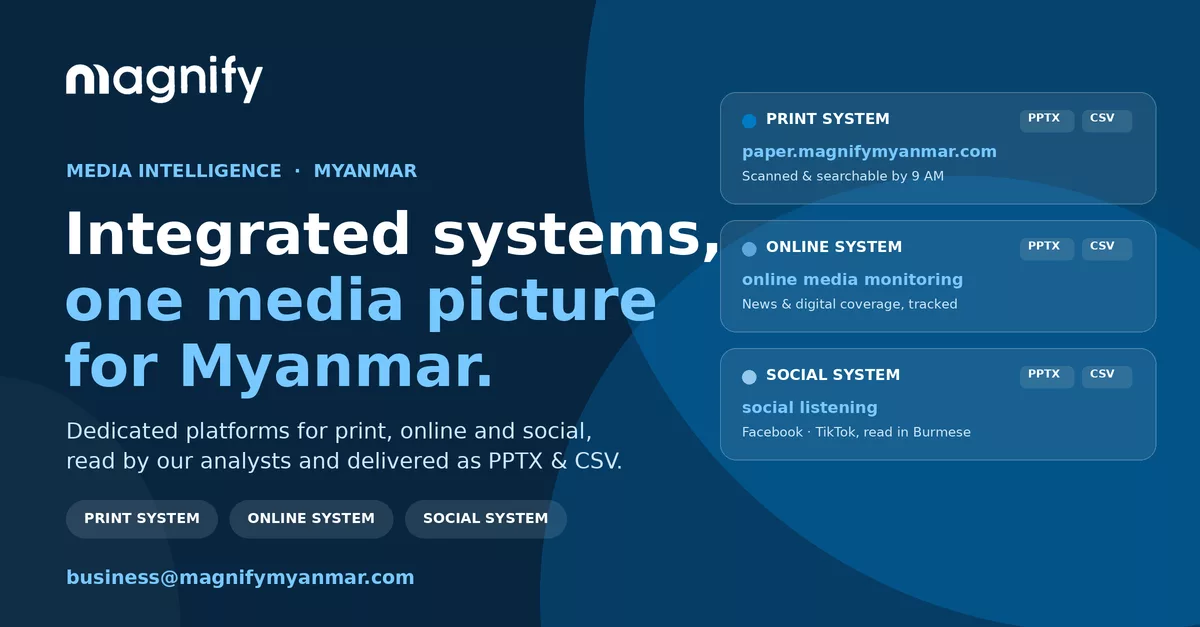
The fix is not a single magic dashboard that claims to do everything at once. Each channel behaves differently and deserves a tool built for it. That is why Magnify runs three specialist media monitoring systems, one for print, one for online, and one for social, all built and owned by us, each tuned to how its channel actually works in Myanmar, and all read by the same analysts so the insight comes back to you as one coherent picture. Here is how that works, and why it matters more in this market than almost anywhere else.
Three systems, because three channels are not the same
Print, online and social move at different speeds, in different formats, with different signals. Forcing them into one generic feed flattens exactly the nuances that matter. Magnify keeps a dedicated system for each, so every channel is monitored properly rather than approximately.
The Print System: paper.magnifymyanmar.com
This is the channel the rest of the world has largely retired and Myanmar has not. Newspapers and journals still set the agenda and reach decision-makers who never appear in an online dataset, yet print is the hardest channel to monitor because the content does not arrive in a tidy digital feed. Someone has to actually read the papers.
That is what paper.magnifymyanmar.com does. Every morning the newspapers are scanned and processed, and the coverage is ready for you to search by 9 AM, by any keyword, across that day’s print. Your brand, a competitor, an executive, a policy term. Instead of clipping by hand or learning days later that you were mentioned, you start the day already knowing.
The Online Media System
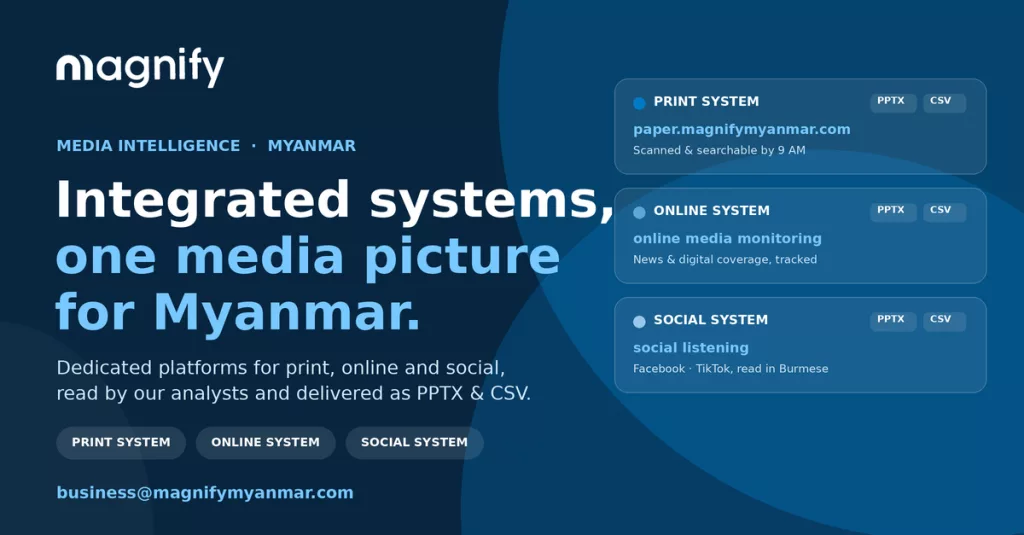
Beyond print sits the fast-moving world of news sites, online journals and digital publications. The Online System tracks where and how your brand is written about across the web, which outlets are driving the story, in what tone, and whether coverage is helping or hurting, so you can measure a campaign’s reach and follow a narrative as it develops.
The Social Listening System
Then there is the public conversation itself, on the platforms where Myanmar spends its attention. The Social System captures the unfiltered voice of your audience across Facebook and TikTok: the praise, the complaints, the questions, and the first tremors of an issue long before it reaches a journalist.
Crucially, this is where reading the language correctly decides everything. Global sentiment tools were built for English-first text and quietly choke on Burmese: no spaces between words, more than one text encoding still in circulation, heavy mixing of Burmese and English, romanised Burmese, slang and relentless sarcasm. Faced with text they cannot parse, they default huge volumes of comments to “neutral.” Neutral is not always neutral. Often it just means the software gave up reading. Our social system is built to read Burmese the way Burmese is actually written and typed, so the sentiment reflects what your audience truly means.
The negative trends, read by people, not by a popup
Here is an important distinction in how Magnify works, and one we think is a strength rather than a limitation.
Our systems surface trends, including negative ones: a sentiment line that turns downward, a cluster of similar complaints, a sudden rise in a worrying topic. What the systems do not do is fire an automatic in-app alert and leave you to interpret a red icon on your own. Instead, every meaningful trend is read and interpreted by our analysts, who trace it to its source, judge how serious it really is, and tell you what it means in plain language.
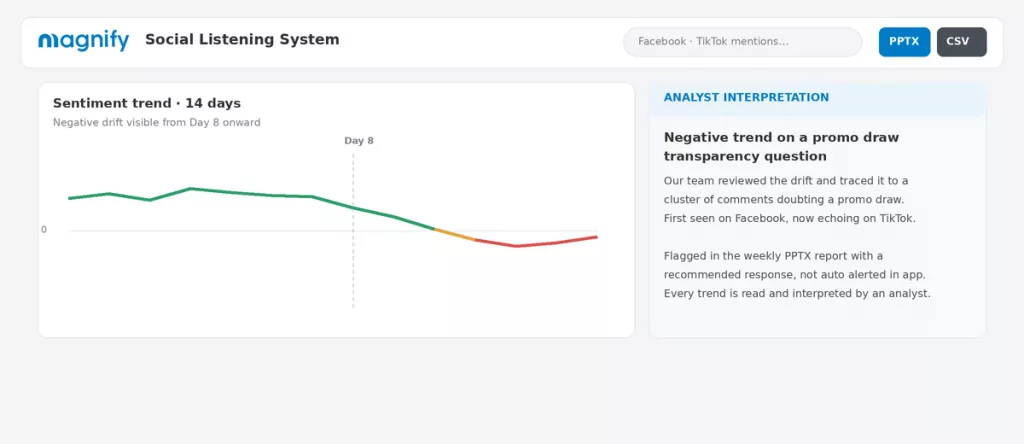
That matters because an automated alert without context creates noise and false alarms. A drop in sentiment might be a genuine problem, or it might be a spike of harmless sarcasm, or one loud voice that will pass by morning. The judgement of whether something deserves your attention is exactly where experience earns its keep. So when Magnify flags a negative trend, it arrives with a cause, a read on severity, and a recommended response, not just a number turning red. You get an interpretation you can act on, not an inbox of alerts you have to decode yourself.
Delivered the way your team actually works: PPTX and CSV
Insight that stays trapped in a tool is insight nobody uses. Magnify delivers from all three systems in the formats communications teams genuinely work in.
Reports come as PowerPoint (PPTX), ready to present to leadership or a client with the narrative and analyst interpretation already built in, and as CSV, so your own analysts can slice the underlying data, build their own views, or feed it into other tools. One is the story for the room; the other is the raw material for deeper work. Between them, the insight moves easily from our systems into your meetings and your own analysis.
Why this combination wins in Myanmar
Put the three together and the picture becomes whole. A complaint first seen on social, a question that surfaces online, a column that lands in print, all read by the same team that can see how the story is moving between channels, and reported back to you in PPTX and CSV with a human interpretation attached.
That combination delivers what every communications team actually wants:
- Print that’s never a blind spot. Searchable by 9 AM through paper.magnifymyanmar.com, not ignored the way global tools ignore it.
- Online coverage tracked as it publishes, so you can prove reach and follow the narrative.
- Social read in Burmese, for what your audience truly means, not rounded to a meaningless “neutral.”
- Negative trends interpreted by analysts, with cause, severity and a recommended response, instead of an alert you must decode alone.
- Reports in PPTX and CSV, ready for the boardroom and for your own deeper analysis.
- Share of voice and sentiment you can put in front of leadership to show that PR is a driver, not a cost.
See your whole story, every morning
At Magnify, we built three specialist systems for the three pillars of the Myanmar media landscape, all owned and run by us, so your team never has to choose which part of the story to miss. Print scanned and searchable by 9 AM through paper.magnifymyanmar.com, online coverage tracked as it publishes, and social conversation read in Burmese for what it really means, with every trend interpreted by our analysts and delivered to you in PPTX and CSV.
If your monitoring today leaves print as a blind spot, or hands you a suspiciously calm “neutral” you do not quite trust, or buries you in context-free alerts, those are exactly the gaps this approach closes.
Let’s build your morning media view. Reach our team at business@magnifymyanmar.com and we will show you what it looks like to start every day already knowing the whole story, across every channel, interpreted and ready to present.
Magnify Myanmar. Media Monitoring, Social Listening & Market Intelligence, built for Myanmar.
What Is the Market Saying About Your Brand?
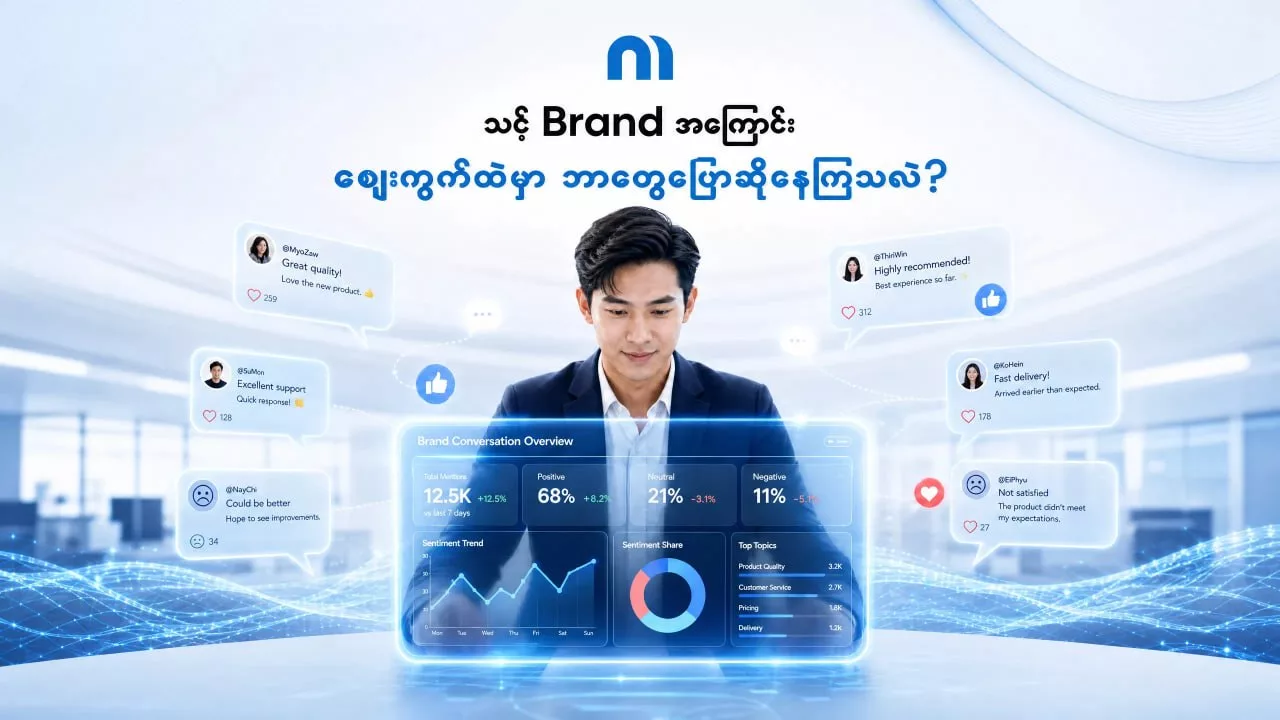
Every day, conversations about your brand take place across social media, online news platforms, blogs, forums, and digital communities. Customers share experiences, journalists publish stories, influencers express opinions, and competitors shape market trends.
The question is: Are you listening?
Understanding what people are saying about your brand is essential to protecting your reputation, identifying opportunities, and making informed business decisions. Positive conversations can strengthen trust and loyalty, while negative feedback, misinformation, or emerging issues can quickly impact public perception if left unmanaged.
In today’s fast-moving digital landscape, a single post, review, or media mention can influence thousands of people within hours. Businesses need more than occasional monitoring—they need real-time insights into market conversations and audience sentiment.
Why Choose Magnify Myanmar?
Magnify Myanmar’s Media Monitoring & Social Listening Solution helps organizations transform online conversations into actionable business intelligence.
- Reputation Risk Detection
Identify potential reputation threats early through real-time monitoring of brand mentions, allowing your team to respond proactively before issues escalate.
- Measure PR & Campaign Performance
Track media coverage across multiple channels and evaluate the effectiveness of your communication efforts with Advertising Value Equivalency (AVE) and performance analytics.
- Audience Sentiment Analysis
Understand how customers perceive your brand, products, and campaigns. Discover key drivers of positive engagement and areas that need improvement.
- Competitor & Industry Monitoring
Stay informed about competitor activities, industry developments, emerging trends, and changing consumer behaviors to maintain a competitive advantage.
- Comprehensive Digital Coverage
Monitor and analyze conversations from social media platforms, online news portals, blogs, forums, digital publications, and other online sources through a centralized dashboard.
- Data-Driven Decision Making
Convert large volumes of online data into meaningful insights that support strategic planning, marketing optimization, risk management, and business growth.
Stay Ahead with Smarter Listening
Successful brands are not always the ones that speak the loudest—they are the ones that listen the smartest.
Magnify Myanmar helps you uncover valuable insights behind online conversations, empowering your organization to strengthen brand reputation, understand customer sentiment, and stay ahead of the competition.
Get Started Today
Discover how Media Monitoring & Social Listening can help your business grow with confidence.
Contact Magnify Myanmar today to learn more about our solutions and schedule a consultation.
Media Monitoring in Myanmar 2026: Print, Online and Social, in One Morning View
Ask a communications team in most of the world about media monitoring and they will talk about online articles, broadcast clips and social feeds. Ask the same question in Myanmar and you hit a fact the global playbook quietly forgets.
Here, print still matters. A great deal.
Newspapers, journals and weekly publications continue to shape opinion, set the agenda for the day, and reach audiences and decision-makers that never surface in an online dataset. A brand or organisation watching only the internet in Myanmar is watching an incomplete picture, confidently, every single day.
So a serious media monitoring strategy in this market is not a choice between print, online and social. It is all three, read together, fast enough to act on. This is a guide to what that actually takes in 2026, and where most setups fall short.
Why media monitoring matters more than ever
The job of media monitoring has not changed in spirit, but the stakes have risen. Communications and PR teams use it to do several things at once: protect reputation, prove the value of their work, watch competitors, and catch a problem while it is still small.
What has changed is speed. A story now travels from a single post or a single column to widespread awareness in hours, sometimes less. The window between “something is happening” and “everyone knows” has narrowed to the point where monitoring on a weekly, or even daily-but-late, basis is no longer monitoring. It is record-keeping after the fact.
The teams that stay ahead are the ones who see the coverage as it lands, across every channel where their audience actually pays attention, and who can search their entire media footprint the moment a question is asked. That last part is where most monitoring quietly breaks down.
The three pillars, and the one everyone underestimates
A complete view of the Myanmar media landscape rests on three pillars. Each answers a different question.
Print media monitoring
This is the pillar the rest of the world has largely retired and Myanmar has not. Print carries weight here, with credibility, reach, and influence over the people who matter, yet it is the hardest channel to monitor because the content does not arrive in a neat digital feed. Someone, or something, has to actually read the papers.
This is exactly the gap paper.magnifymyanmar.com was built to close. Every day, the newspapers are scanned and processed, and the coverage is ready for you by 9 in the morning, in a dashboard where you can search any keyword across that print content. Your brand, a competitor, an executive’s name, a policy term, a campaign slogan. Instead of clipping by hand or finding out days later that you were mentioned, you start the day already knowing.
The value is in the routine. Coverage you can rely on being there, searchable, before your first meeting, turns print from a blind spot into one of your sharpest early-warning channels.
Online media monitoring
Beyond print sits the fast-moving world of news sites, online journals and digital publications. Online monitoring tracks where and how your brand is being written about across the web, who is saying it, in what context, and whether the coverage is helping or hurting. It is how you measure the reach of a campaign, follow a story as it develops across outlets, and understand the narrative forming around you in close to real time.
Social media monitoring
Then there is the conversation the public is having directly, on the platforms where Myanmar spends its attention. Social monitoring is where you hear the unfiltered voice of your audience: the praise, the complaints, the questions, the sentiment, and the first tremors of an issue long before it reaches a journalist. It is the most candid of the three, and the most revealing.
Each pillar on its own gives you a slice. The power is in holding all three at once, because that is the only way to see a story move. A complaint on social becomes a question to a journalist, becomes a column in print, becomes a wider online narrative. Watch one channel and you catch a fragment. Watch all three and you watch the whole arc, in time to shape it.
What good monitoring looks like in practice
Tools matter less than what they let you do. A media monitoring setup is working well when it delivers a few specific things.
- Speed you can build a morning around. Coverage should reach you early and predictably, not whenever it happens to be compiled. A dependable 9 AM print briefing is worth more than a faster feed you cannot count on.
- Search across everything. The real test is the moment a leader asks “what are they saying about us?” If you can type a keyword and pull every mention across print, online and social in seconds, you have a monitoring system. If you cannot, you have an archive.
- Sentiment that fits the market. Knowing you were mentioned is half the story. Knowing whether the mention helps or hurts, read correctly for how Myanmar audiences actually express themselves, is the other half.
- A single view, not five tabs. Coverage scattered across separate tools for separate channels is coverage no one has time to connect. One dashboard that brings print, online and social together is what turns monitoring into intelligence.
- Proof for the people you report to. Good monitoring quietly answers the hardest question in communications: did our work land? Reach, share of coverage, sentiment shift, and competitive comparison are how a comms team shows its value in numbers.
Where this is heading
Media monitoring in Myanmar is moving the same direction as everywhere else, toward faster, smarter, more automated reading of more sources at once. AI is making it possible to process far more coverage, summarise it, and surface what matters without a human scanning every line.
But the Myanmar-specific truth holds underneath the technology. The market that monitors print, online and social together, in a language and a media reality the global tools were not built for, sees more than the market that monitors only what is convenient. The advantage is not just having the data. It is having the whole of it, early enough to do something with it.
See your whole media picture, every morning
At Magnify, we monitor all three pillars of the Myanmar media landscape so your team never has to choose which part of the story to miss. Print scanned and searchable by 9 AM through paper.magnifymyanmar.com, online coverage tracked as it publishes, and social conversation read for what it really means, brought together where you can search it, measure it, and act on it.
If your current monitoring leaves print as a blind spot, or scatters your coverage across tools that do not talk to each other, it is worth a conversation.
Let’s build your morning media view. Reach our team at business@magnifymyanmar.com and we will show you what it looks like to start every day already knowing the whole story.
Magnify Myanmar — Media Monitoring, Social Listening & Market Intelligence, built for Myanmar.
Why Most Social Listening Tools Are Functionally Illiterate in Myanmar
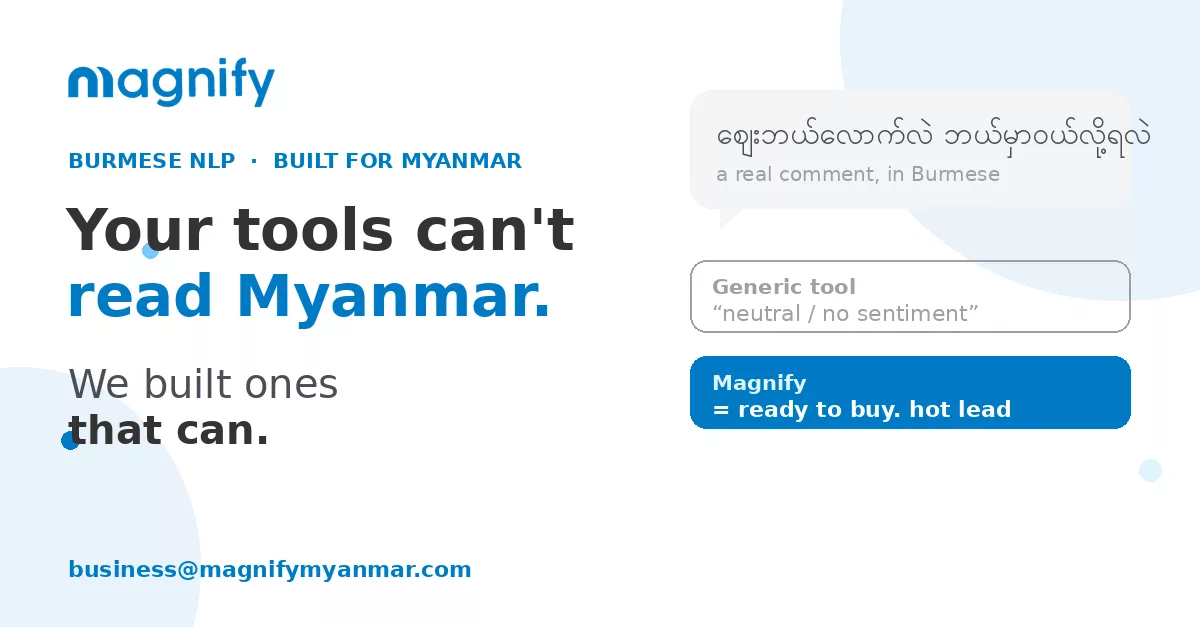
There is an uncomfortable truth behind a lot of social listening in Myanmar, and almost nobody says it out loud.
Most of the tools doing the listening cannot actually read.
Not properly. Not the way the language is really used. A global platform will happily produce a clean dashboard full of confident charts about your Myanmar audience, and a good portion of what feeds those charts is the software politely guessing, because the language defeated it somewhere upstream. The charts still look great. That is the dangerous part.
If you are making brand decisions off that data, it is worth understanding exactly where the reading breaks down, and why this is a genuinely hard problem rather than a lazy one.
Burmese was built to break English-first software
Most of the world’s natural language processing was designed around languages like English. Words separated by spaces, a familiar alphabet, decades of training data. Burmese quietly violates almost every one of those assumptions.
There are no spaces between words. This sounds like a small thing. It is not. In English, software finds words by looking for the gaps. Burmese traditionally does not put gaps between words at all, so before a tool can analyse anything, it first has to figure out where one word even ends and the next begins. This is a famously hard problem called word segmentation, and it is the foundation everything else is built on. Get it wrong, and the meaning collapses.
Here is the easiest way to feel it. Imagine an English comment arrived with no spaces: “thefoodwasnotbadatall.” Now imagine your software splits it in the wrong place and reads “not” as belonging to a different phrase. A glowing review just became a complaint, or a complaint became praise. In Burmese, that ambiguity is not an edge case. It is every single sentence.
There were two competing ways to type the language. For years, Myanmar was split between two incompatible text encodings, Zawgyi and Unicode. The same comment could be stored in two completely different ways under the hood. A tool that only understands one of them sees the other as gibberish. Even today, older content and some users still produce text that has to be detected and converted before it can be read at all. Skip that step, and you are not analysing a chunk of your audience, you are silently dropping them.
Burmese is a low-resource language. In plain terms, the global research and training data that makes AI fluent in English, Spanish or Chinese barely exists for Burmese. Fewer datasets, fewer benchmarks, fewer pre-built tools. When researchers test large language models on lower-resource languages, performance drops off noticeably compared to the major ones. The fluency you take for granted in English simply has not been built yet for Burmese, unless someone deliberately builds it.
Now add how people actually talk online
The script is only the first hurdle. Real Myanmar social media adds a second layer that even many Burmese-aware tools stumble over.
People code-switch constantly, mixing Burmese and English inside a single sentence. They type Burmese using English letters when they cannot be bothered to switch keyboards. They lean on slang, abbreviations, and inside jokes that shift every few months. And like everyone else online, they are heavily sarcastic, and they communicate enormous amounts through emoji and stickers that carry meaning a keyword search will never catch.
A keyword tool counts the word. It has no idea the word was being used to mock you.
So when an off-the-shelf international platform processes Myanmar comments, the most common failure is not a dramatic error. It is something quieter and worse: it shrugs. Unsure how to classify text it cannot fully parse, it defaults huge volumes of comments to “neutral.” Your dashboard then tells you sentiment is calm and balanced, when in reality you are looking at a wall of enthusiasm, or a slow-building complaint, that the software simply could not hear.
Neutral is not always neutral. Sometimes neutral just means “I gave up reading this.”
What changes when the tool can actually read
This is the gap we built Magnify to close, and it is the difference between counting Myanmar and understanding it.
Reading the language properly means handling Burmese the way Burmese is actually written and typed: segmenting words correctly, normalising the encoding mess before analysis rather than after, and recognising mixed Burmese-English, romanised Burmese, slang and sarcasm as real signal instead of noise. That is the unglamorous foundation, and most tools never lay it.
Layering modern language models on top of that foundation is what turns reading into comprehension. Done right for this market, it means a model can tell the difference between a genuine compliment and a sarcastic one. It can recognise that a short, simple question like “how much, and where can I buy it” is not neutral chatter, it is a customer with their wallet open. It can group thousands of differently worded complaints into the handful of real issues underneath them. It can read the emoji as part of the sentence, not as decoration to be stripped out.
The practical payoff is not abstract:
- Sentiment you can trust, because the comments were actually read rather than rounded to neutral.
- Buying signals you would otherwise miss, surfaced as leads instead of buried in a volume count.
- Early warning on trust and quality issues, caught while they are still a handful of comments rather than a crisis.
- A view of your whole audience, including the ones writing in Zawgyi, in slang, or in half-English, who other tools quietly discard.
That last point matters more than it looks. Every comment a tool cannot read is a customer it has decided does not count. In a market this digital and this expressive, that is an expensive blind spot to leave running.
The bottom line
A dashboard is only as honest as the reading underneath it. In Myanmar, the reading is the entire game, and it is precisely where generic, English-first tooling falls quietly short. The language does not bend to fit the software, so the software has to be built to fit the language.
That is the work we do. We built our social listening for Myanmar specifically, on Burmese-aware language processing and models tuned for how this market actually talks, so that the insight you act on is based on what your customers truly said, not on a confident guess about text the tool could not parse.
If you have ever looked at a suspiciously calm “neutral” sentiment score for your Myanmar campaigns and wondered what it was really hiding, that instinct is worth following.
Let’s find out what your audience is actually saying. Reach our team at business@magnifymyanmar.com and we will show you the difference between counting Myanmar and understanding it.
Magnify Myanmar — Social Listening & Market Intelligence, built for Myanmar.

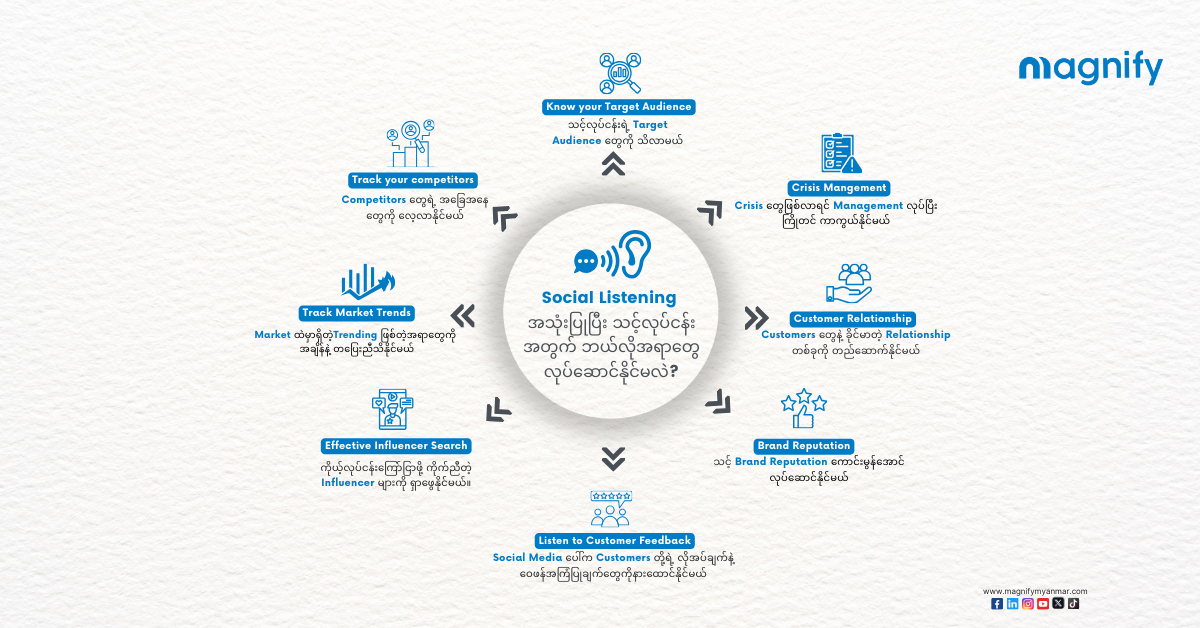
မြန်မာနိုင်ငံက Brands တွေ Social Listening ကို ဘာကြောင့် လုပ်သင့်တာလဲ?
ယနေ့ခေတ်မှာ Consumer တွေဟာ သူတို့ရဲ့ အတွေ့အကြုံတွေနဲ့ ထင်မြင်ယူဆချက်တွေကို ဆိုရှယ်မီဒီယာနဲ့ အွန်လိုင်းပလက်ဖောင်းတွေပေါ်မှာ အမြဲမျှဝေလျက်ရှိပါတယ်။ အဲ့ဒီအကြောင်းအရာတွေက Brand တွေအတွက် ဖောက်သည်တွေရဲ့ အပြုအမူ၊ Market Trend တွေနဲ့ လုပ်ငန်းရဲ့ ပုံရိပ်အပေါ် လေ့လာနိုင်ဖို့ အကောင်းဆုံး အချက်အလက်တွေပဲ ဖြစ်ပါတယ်။
Social Listening ဆိုတာက ဆိုရှယ်မီဒီယာပေါ်မှာ ကိုယ့်လုပ်ငန်းအပေါ် Consumer တွေရဲ့ တုံ့ပြန်မှုတွေ၊ သဘောထားတွေနဲ့ Campaign တွေ ထိရောက်မှု ရှိ၊မရှိ စတာတွေကို စောင့်ကြည့်၊ တိုင်းတာ၊ ခွဲခြမ်းစိတ်ဖြာတဲ့ လုပ်ငန်းစဉ်တစ်ခုဖြစ်ပါတယ်။ ဒါပေမယ့် ကျယ်ပြောလှတဲ့ အင်တာနက် လူမှုကွန်ရက်ပေါ်မှာ ဒီ Process ကို လူကိုယ်တိုင် စောင့်ကြည့် တိုင်းတာဖို့ဆိုတာ အချိန်ကုန်သလောက် အချက်အလက်တွေကလည်း မတိကျနိုင်ပါဘူး။
ဒီပြဿနာကို ဖြေရှင်းပေးနိုင်တာကတော့ Social Listening Tools တွေပဲ ဖြစ်ပါတယ်။ ဒါဆို Social Listening Tools တွေက ဘယ်လိုကူညီပေးနိုင်လဲ?
၁။ ပြိုင်ဘက်တွေကို စောင့်ကြည့်လေ့လာနိုင်ခြင်း။
Social Listening Tools တွေက ကိုယ့်လုပ်ငန်းအပြင် ပြိုင်ဘက် Brand တွေဘာတွေလုပ်နေလဲ၊ ဘယ်လို Content မျိုးတွေ တင်နေလဲ၊ Audience Engagement နဲ့ Campaign Performance ဘယ်လောက်ရှိလဲဆိုတာပါ စောင့်ကြည့် လေ့လာနိုင်ပါတယ်။ ရရှိလာတဲ့ အချက်အလက်တွေကနေတစ်ဆင့် ပြိုင်ဘက်တွေရဲ့ အားနည်းချက်ကို မိမိတို့ရဲ့ အားသာချက်အဖြစ် ပြောင်းလဲနိုင်တာကြောင့် ပြိုင်ဘက်တွေထက် ခြေတစ်လှမ်းသာနေမှာပဲ ဖြစ်ပါတယ်။
၂။ အချက်အလက်အားလုံးကို Dashboard တစ်ခုတည်းမှာ အလွယ်တကူ ကြည့်ရှုနိုင်ခြင်း။
ဆိုရှယ်မီဒီယာပေါ်က အချက်အလက်အားလုံးကို Dashboard တစ်ခုတည်းမှာ စုစည်းကြည့်ရှုနိုင်တာကြောင့် အချိန်ကုန်သက်သာစေပြီး ပိုပြီးတိကျခိုင်မာတဲ့ ဆုံးဖြတ်ချက်တွေကို မြန်မြန်ဆန်ဆန် ချမှတ်နိုင်မှာပဲ ဖြစ်ပါတယ်။ ဒါ့အပြင် Visual Dashboard တွေက Campaign တွေရဲ့ Performance, Audience Behavior နဲ့ Market Trends တွေကို အလွယ်တကူ နားလည်စေပါတယ်။
၃။ ကိုယ့် Brand အကြောင်း ဘယ်သူတွေ ပြောနေလဲဆိုတာ အတိအကျ သိနိုင်ခြင်း။
ဘယ်မီဒီယာတွေ၊ ဘယ် Influencer တွေနဲ့ ဘယ် Page တွေက ကိုယ့် Brand အကြောင်း အများဆုံး ပြောနေလဲ၊ ဘယ်သူ့ဆီက Engagement အများဆုံး ရလဲဆိုတာကို သိနိုင်ပါတယ်။ ဒီအချက်အလက်တွေက Media တွေနဲ့ ပိုကောင်းတဲ့ Relationship ဆောက်နိုင်သလို Content Strategy တွေကိုပါ ပိုကောင်းအောင် ပြင်ဆင်နိုင်မှာပါပဲ ဖြစ်ပါတယ်။
၄။ Market Trends နဲ့ Customer Sentiment တွေကို အမြဲ စောင့်ကြည့်နိုင်ခြင်း။
Customer တွေရဲ့ သေဘာထားတွေနဲ့ ခံစားချက်တွေကို နားလည်ခြင်းက လုပ်ငန်းတိုင်းအတွက် အရေးကြီးပါတယ်။ Social Listening Tools တွေက အွန်လိုင်းပေါ်က Conversation တွေကို အချိန်နဲ့တပြေးညီ စောင့်ကြည့်ပေးနိုင်တာကြောင့် Market Trends တွေ၊ Customer တွေရဲ့ အခက်အခဲတွေနဲ့ ပြောင်းလဲလာတဲ့ အကြိုက်တွေကို အချိန်မီ သိရှိနိုင်ပါတယ်။
ဒါ့အပြင် Sentiment Analysis Feature တွေကနေတစ်ဆင့် လူတွေပြောနေတာက အပြုသဘော (Positive) လား၊ ပုံမှန် (Neutral) ပဲလား၊ ဒါမှမဟုတ် အပျက်သဘော (Negative) ဆန်နေလား ဆိုတာကိုပါ ခွဲခြားသိမြင်နိုင်ပါတယ်။
၅။ Dashboard တွေနဲ့ Report တွေကတစ်ဆင့် အလွယ်တကူ ဆုံးဖြတ်ချက်ချနိုင်ခြင်း။
ကိုယ့်လုပ်ငန်းရဲ့ Target Customers တွေနဲ့ အကိုက်ညီဆုံးဖြစ်မယ့် KPI တွေကို စိတ်ကြိုက်ပြင်ဆင်နိုင်တဲ့ Customizable Dashboard တွေကနေ အချိန်နဲ့ တပြေးညီစောင့်ကြည့်နိုင်ပါတယ်။ Export ထုတ်လို့ရတဲ့ Report တွေကနေတစ်ဆင့် Campaign Performance နဲ့ Market အခြေအနေတွေကို ရှင်းရှင်းလင်းလင်း သိနိုင်လို့ ပိုကောင်းတဲ့ ဆုံးဖြတ်ချက်တွေ ချနိုင်မှာပါ။ ဒီလို Customized Reports တွေကို Client တွေ၊ Management Team တွေဆီ ပြန်လည် တင်ပြရတာလည်း အချိန်ကုန်သက်သာပြီး ပိုအဆင်ပြေစေပါတယ်။
Magnify Myanmar နဲ့အတူ ပိုမိုကောင်းမွန်တဲ့ ဆုံးဖြတ်ချက်တွေကို ချမှတ်လိုက်ပါ။
Magnify Myanmar ကတော့ မြန်မာနိုင်ငံရဲ့ နံပါတ်(၁) ထိပ်တန်း Social Listening နဲ့ Analytics Platform တစ်ခုဖြစ်ပြီး ဆိုရှယ်မီဒီယာနဲ့ အွန်လိုင်းပေါ်က အကြောင်းအရာတွေအပြင် သတင်းစာတွေ၊ ဂျာနယ်တွေအထိ စောင့်ကြည့်ပေးနိုင်ခြင်း၊ မြန်မာလိုရော အင်္ဂလိပ်လိုပါ စောင့်ကြည့်လေ့လာနိုင်ခြင်း၊ နားလည်ရလွယ်တဲ့ Dashboard တွေနဲ့ Report တွေကို လိုအပ်သလိုထုတ်နိုင်ခြင်း စတာတွေကို အကောင်းဆုံး လုပ်ဆောင်ပေးနိုင်ပါတယ်။
လုပ်ငန်းတွေအတွက် လိုအပ်တဲ့ Advanced Dashboards, Competitor Analysis, Media Monitoring, Sentiment Analysis နဲ့ Customizable Reporting စတဲ့ Feature အစုံအလင် ပါဝင်တာကြောင့် ဆုံးဖြတ်ချက်တွေ ချမှတ်တဲ့အခါ Data တွေကို အခြေခံပြီး မြန်မြန်ဆန်ဆန်နဲ့ ထိရောက်စွာ ချမှတ်နိုင်ဖို့ ကူညီပေးနိုင်ပါတယ်။
ကိုယ့်ရဲ့ Brand Reputation ကို စောင့်ကြည့်ချင်တာပဲဖြစ်ဖြစ်၊ Campaign Performance ကို တိုင်းတာချင်တာပဲဖြစ်ဖြစ်၊ Market Trends အသစ်တွေကို ရှာဖွေချင်တာပဲဖြစ်ဖြစ်၊ Customer Sentiment ကို ပိုနားလည်ချင်တာပဲဖြစ်ဖြစ် Magnify Myanmar က လုပ်ငန်းအောင်မြင်ဖို့ လိုအပ်တဲ့ Actionable Insights တွေကို ထုတ်ပေးနိုင်ပါတယ်။
Magnify Myanmar နဲ့အတူ Data တွေကို အသုံးချပြီး လုပ်ငန်းအတွက် ပိုမိုကောင်းမွန်တဲ့ ဆုံးဖြတ်ချက်တွေအဖြစ် အမြန်ဆုံးပြောင်းလဲလိုက်ပါ။
Contact Us: business@magnifymyanmar.com (သို့) ဖုန်းနံပါတ် 09 408104400 သို့ ခေါ်ဆိုကာ Free Trial အတွက် ဆက်သွယ်စုံစမ်း မေးမြန်းနိုင်ပါတယ်။
In Microfinance, Trust Takes Years to Build and Seconds to Lose. Protect It Real-Time.
“Interest rates are confusing.”
“The application process is too complicated.”
“I switched to a provider with better service.”
In the financial and microfinance sectors, these are critical customer friction points that executives and operations teams look out for. Your customers won’t always complain directly in your page’s chatbox. Instead, their real opinions, frustrations, and recommendations are shared across Facebook comments, group discussions, and review posts.
For Microfinance Institutions (MFIs), staying ahead means listening to every digital corner. This is why incorporating a robust Social Listening Tool into your strategy is no longer optional, it’s essential.
Here is how Magnify Myanmar empowers your business to track, analyze, and act on customer insights.
- Real-Time Feedback Across All Channels
We monitor online platforms alongside offline sources like newspapers and journals. You will never miss a critical mention, even when you can’t physically track them yourself.
- AI-Powered Sentiment Analysis
Our AI technology accurately decodes the true emotions behind borrower comments whether they are positive, negative, neutral, or showing high intent for new loan products. This allows you to resolve pain points faster than your competitors.
- Proactive Crisis Management
In the financial sector, a single negative issue can go viral in minutes. Magnify’s Early Warning System alerts you instantly, allowing you to protect your brand reputation before a crisis escalates.
Don’t let valuable customer insights slip away. Empower your MFI to resolve borrower pain points in real-time, mitigate risks, and drive better customer retention with Magnify Myanmar.
Leveraging Social Listening for Strategic Business Growth
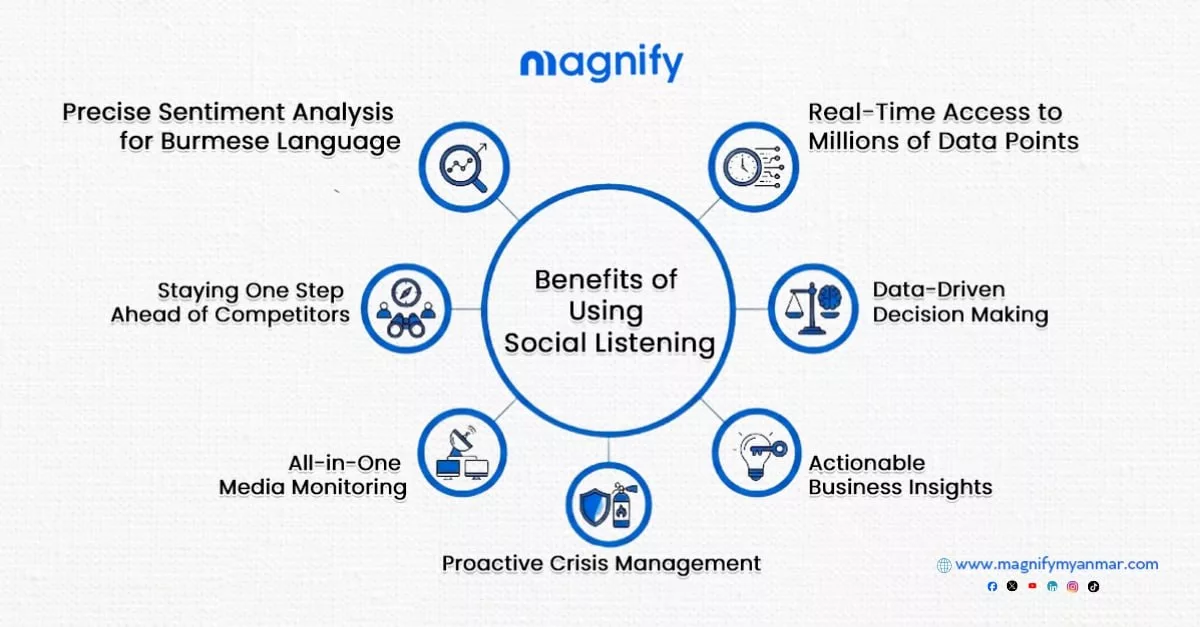
In the 21st-century business landscape, a brand’s success is no longer just about “broadcasting your message”, it is about “actively listening to your consumers”. With the rapid nature of social media, a single piece of negative feedback can impact a company’s reputation within seconds. This makes Social Listening far more than just a tool, it is a vital strategic asset that empowers business leaders to make precise, data-driven decision.
Here is how implementing Social Listening can transform your business outcomes:
- Real-Time Processing of Millions of Data Points
In today’s digital era, data multiplies by the second. Social Listening automatically monitors massive volumes of data that are impossible to track manually, ensuring you capture market trends and customer insights instantly.
- Omnichannel Monitoring (Online & Offline)
Seamlessly track conversations across social networks, online media, and blogs. In addition, monitor critical offline sources like newspapers and journals to maintain a 360-degree view of your brand presence.
- Accurate Myanmar Language Sentiment Analysis
Navigating localized slang, modern buzzwords, and nuanced context can be challenging. Leveraging advanced Natural Language Processing (NLP) technology, you can accurately decode the true emotional sentiment behind the text.
- Data-Driven Decision Making
Move away from guesswork. By systematically analyzing customer comments, reviews, and engagement metrics, you can craft highly targeted business and marketing strategies backed by concrete data.
- Maintaining a Competitive Edge
Stay a step ahead by monitoring competitor movements, analyzing how audiences perceive their brand, tracking their campaigns, and measuring emerging trends in real time.
- Proactive Crisis Management
Real-time data acquisition allows you to identify potential reputational risks before they escalate. Intervene early, control the narrative, and protect your brand equity.
- Actionable Business Intelligence
Transform complex data into intuitive, easy-to-read dashboards. Generate comprehensive reports on demand to save time and streamline your executive decision-making process.
Why Partner with Magnify Myanmar?
Magnify Myanmar is more than just a software tool, it is an All-in-One Business Intelligence System purpose-built for the local market context. Backed by Myanmar’s most robust Big Dataset Archive, the platform is capable of monitoring over 3 million posts and 400 million engagements per hour, ensuring no critical data point goes unnoticed.
Key Proprietary Features:
- Advanced “Interest” Tagging
Filters out the noise to identify high-intent audiences who are genuinely interested in your business.
- Real-Time Crisis Alerts
Notifies your team instantly regarding negative sentiment, allowing you to safeguard your corporate reputation immediately.
Ready to elevate your business strategies with precision insights? Partner with Magnify Myanmar to unlock the full potential of your market data.
Contact us today at 09-408104400 to schedule a consultation and activate your Free Trial.
“Social Listening: The New Competitive Advantage for Banking & Finance Brands”
In today’s Banking & Finance industry, trust is the foundation of long-term success. As social media usage continues to grow rapidly, customers are increasingly sharing their experiences, opinions, concerns, and frustrations about banks online in real time. A single positive review can strengthen a bank’s reputation, while one negative comment can damage public trust within minutes.
With millions of posts and engagements generated every day, one of the biggest challenges facing financial institutions is keeping track of what customers are saying about their brand in real time. In this digital landscape, Social Listening has become an essential tool for modern banking organizations.
Social Listening is the process of monitoring and analyzing conversations across social media platforms, online news sources, forums, reviews, and public discussions to understand how people perceive a brand. It enables businesses to identify trends, customer sentiment, emerging issues, and market opportunities as they happen.
This is where Magnify Myanmar’s Social Listening System provides a powerful solution for the banking industry. No matter how large the volume of data becomes or how complex customer conversations are, Magnify Myanmar’s Big Dataset System can monitor both online and offline sources in real time. Beyond social media and digital platforms, the system can also track information from newspapers, journals, and other traditional media sources that are difficult to monitor manually. As a result, banks no longer risk missing critical customer feedback or important public conversations related to their brand.
In addition, Magnify Myanmar’s AI-powered technology is designed to accurately analyze the true sentiment behind complex Myanmar-language comments and conversations. The system can distinguish whether discussions are positive, negative, neutral, or categorized under Magnify Myanmar’s exclusive “Interest” classification, which identifies users actively seeking information or showing intent toward a banking service. This allows banks to identify customer pain points earlier than competitors and respond more effectively to customer needs.
These real-time insights create a major advantage for improving customer experience. In the banking industry, issues can become viral within seconds. System errors, transaction delays, ATM problems, security rumors, and customer service complaints can spread rapidly across social media and significantly impact a bank’s reputation if not addressed immediately.
With Magnify Myanmar’s real-time Social Listening capabilities, banks can detect potential risks early, receive proactive alerts, and take immediate action before issues escalate. This helps financial institutions protect customer trust and maintain a strong brand reputation in an increasingly competitive digital environment.
Today’s banking customers are more influenced by user reviews and public conversations than by traditional advertising. That is why understanding customer concerns, responding quickly to feedback, and preventing reputation crises have become critical business strategies for financial institutions.
In the era of digital competition, Social Listening is no longer just a marketing tool, it has evolved into a powerful Business Intelligence System that helps organizations build trust, strengthen customer relationships, and achieve long-term growth.
To stay connected with customer voices in real time and build a stronger brand reputation, partnering with Magnify Myanmar can help your business stay ahead in the modern banking landscape.
“Banking Industry အတွက် Social Listening က ဘယ်လောက်အရေးပါသလဲ?”
ယနေ့ခေတ် Banking & Finance Industry မှာ “ယုံကြည်မှု” ဆိုတာ အဓိက အသက်သွေးကြောပဲ ဖြစ်ပါတယ်။ အထူးသဖြင့် Social Media အသုံးပြုမှု အလွန်မြင့်မားလာတဲ့ ယနေ့ခေတ်မှာ ဘဏ်နဲ့ပတ်သက်ပြီး ငွေကြေးသုံးစွဲသူတွေဟာ သူတို့ရဲ့ အတွေ့အကြုံတွေ၊ သဘောထားတွေ၊ အဆင်မပြေမှုတွေကို Online ပေါ်မှာ ချက်ချင်း မျှဝေနေကြပါတယ်။ Positive Review တစ်ခုက လုပ်ငန်းရဲ့ ပုံရိပ်ကို မြှင့်တင်ပေးနိုင်သလို Negative Comment တစ်ခုကလည်း လုပ်ငန်းရဲ့ ပုံရိပ်ကို အချိန်တိုအတွင်း ဆွဲချသွားနိုင်ပါတယ်။
တစ်နေ့ကို Post သိန်းပေါင်းများစွာ၊ Engagement ပေါင်း သန်းနဲ့ချီ ဖြစ်ပေါ်နေတဲ့အချိန်မှာ “ဘဏ်သုံးစွဲသူတွေက သင့်ဘဏ်အကြောင်း ဘာတွေပြောနေကြလဲ” ဆိုတာကို အချိန်နဲ့တပြေးညီ မသိရှိနိုင်ခြင်းက ဘဏ်လုပ်ငန်းေတွအတွက် အလွန်ကြီးမားတဲ့ စိန်ခေါ်မှုတစ်ရပ် ဖြစ်လာပါတယ်။ ဒီလိုအခြေအနေမှာ Social Listening ဟာ ဘဏ်လုပ်ငန်းတွေအတွက် မရှိမဖြစ်လိုအပ်တဲ့ အရာတစ်ခု ဖြစ်လာပါတယ်။ Social Listening ဆိုတာ Social Media Platforms တွေ၊ Online News Sources တွေ၊ Forums တွေ၊ Reviews တွေ နဲ့ Public Conversations တွေထဲမှာ ကိုယ့်လုပ်ငန်းအကြောင်းပြောဆိုနေမှုတွေကို အချိန်နဲ့ တပြေးညီ စနစ်တကျခွဲခြားပေးတဲ့ လုပ်ငန်းစဥ်တစ်ခု ဖြစ်ပါတယ်။
Magnify Myanmar ရဲ့ Social Listening System ကတော့ ဘဏ်လုပ်ငန်းတွေ ကြုံတွေ့နေရတဲ့အခက်အခဲတွေကို ဖြေရှင်းပေးနိုင်တဲ့ တစ်ခုတည်းသော အဖြေပဲ ဖြစ်ပါတယ်။ Data တွေ ဘယ်လောက်များနေပါစေ၊ Customers တွေရဲ့ ပြောဆိုမှုတွေ ဘယ်လောက်ရှုပ်ထွေးကျယ်ပြန့်နေပါစေ Magnify Myanmar ရဲ့ Big Dataset System က Online Sources တွေအပြင် လူကိုယ်တိုင် လိုက်မကြည့်နိုင်တဲ့ သတင်းစာ၊ ဂျာနယ်စတဲ့ Offline Sources တွေထဲက အချက်အလက်တွေကိုပါ အချိန်နဲ့ တပြေးညီစောင့်ကြည့်နိုင်တာကြောင့် သင့်ဘဏ်နဲ့ ပတ်သက်တဲ့ အရေးကြီးတဲ့ တုံ့ပြန်မှု Feedback တွေ တစ်ခုမှ လွတ်သွားမှာ မဟုတ်တော့ပါဘူး။
ဒါ့အပြင် နားလည်ရ ခက်ခဲလှတဲ့ မြန်မာဘာသာနဲ့ ရေးသားထားတဲ့ Comments တွေရဲ့ နောက်ကွယ်က တကယ့် စိတ်ခံစားချက်ေတွကိုလည်း Magnify Myanmar ရဲ့ AI-powered Technology က တိကျစွာ ခွဲခြားပေးနိုင်ပါတယ်။ Customer တွေပြောနေတဲ့ အကြောင်းအရာတွေက ကောင်းတာလား၊ ဆိုးတာလား၊ ပုံမှန်အကြောင်းအရာပဲလား၊ ဒါ့အပြင် Magnify Myanmar တစ်ခုတည်းမှာသာ ခွဲခြားပေးနိုင်တဲ့ “Interest” ဆိုတဲ့ ကိုယ့်လုပ်ငန်းအကြောင်း စိတ်ဝင်တစား မေးမြန်းနေတဲ့ အကြောင်းအရာဆိုတာတွေကိုပါ ခွဲခြားပေးနိုင်တာကြောင့် ဘဏ်တွေအနေနဲ့ ဘဏ်သုံးစွဲသူတွေရဲ့ အခက်အခဲတွေကို ပြိုင်ဘက်တွေထက် အရင်ဆုံး သိရှိပြီး ဖြေရှင်းနိုင်မှာပဲ ဖြစ်ပါတယ်။ ဒီလို အချိန်နဲ့ တပြေးညီ သိရှိနိုင်တဲ့ Insight တွေက Customer Experience Improvement အတွက် အားသာချက်တစ်ခု ဖြစ်လာပါတယ်။
Banking Industry မှာ ပြဿနာတစ်ခုဟာ စက္ကန့်ပိုင်းအတွင်း Viral ဖြစ်သွားနိုင်ပါတယ်။ System Error, Transaction Delay, ATM Issues, Security Rumors, Customer Service စတဲ့ သတင်းတွေဟာ Social Media ပေါ်မှာ အလွန်မြန်ဆန်စွာ ပြန့်နှံ့နိုင်တာကြောင့် ကြိုတင်မတားဆီနိုင်ရင် လုပ်ငန်းရဲ့ ပုံရိပ်ကို ထိခိုက်စေနိုင်ပါတယ်။ Magnify Myanmar ရဲ့ Social Listening ကနေ Real Time Insights ကို သိရှိနိုင်တဲ့အတွက် ကြောင့် ပြဿနာဖြစ်လာနိုင်မယ့် အကြောင်းအရာတွေကို အစောဆုံး ကြိုတင် သတိေပးနိုင်ပြီး ဘဏ်တွေအနေနဲ့ ဘဏ်သုံးစွဲသူေတွရဲ့ ယုံကြည်မှုကို ထိန်းထားနိုင်မှာ ဖြစ်ပါတယ်။
ဒီနေ့ခေတ် Banking & Finance Sector မှာ ဘဏ်သုံးစွဲသူတွေက ဘဏ်လုပ်ငန်းဘက်က ေကြာ်ငြာတာထက် သုံးစွဲသူေတွရဲ့ Reviews ေတွကို ပိုပြီး ယုံကြည်လက်ခံလာကြပါတယ်။ ဒါကြောင့် သုံးစွဲတွေရဲ့ အခက်အခဲေတွကို အချိန်မီသိရှိပြီး၊ ပြဿနာတွေကို အချိန်မီ ကာကွယ်နိုင်ခြင်းဟာ Banking Industry အတွက် မဖြစ်မနေလိုအပ်လာတဲ့ Business Strategy တစ်ခု ဖြစ်နေပါပြီ။ Digital Competition ေတွကြားမှာ ယုံကြည်မှုကို တည်ဆောက်ပြီး ရေရှည်အောင်မြင်ချင်တဲ့ လုပ်ငန်းတွေအတွက် Social Listening ဟာ Marketing Tool တစ်ခုထက်ပိုတဲ့ Business Intelligence System တစ်ခု ဖြစ်လာပါတယ်။
ဒါေကြာင့် သုံးစွဲသူတွေရဲ့ အသံကို အချိန်နဲ့တပြေးညီ နားစွင့်ပြီး သင့်လုပ်ငန်းရဲ့ ပုံရိပ်ကို ပိုမိုေကာင်းမွန်လာအောင် တည်ဆောက်နို်င်ဖို့ Magnify Myanmar နဲ့အတူ လက်တွဲဖို့ အကြံပြုလိုက်ပါတယ်။
Myanmar Social Media Marketing: Market Research & Strategy
Executive Summary: Myanmar’s digital growth has accelerated: by late 2025 there were ~39.8 million internet users (72.5% penetration) and 21.0 million active social media accounts[1][2]. Leading platforms are TikTok (≈19.6M adult users) and Facebook (≈13.1M users)[3], with robust usage on messaging apps (Viber ≈15M, Messenger ≈13.5M)[4][5]. The population skews young (median age ~30)[6] and mobile-first (62.5M mobile connections, 114% of population)[7]. Consumers engage most with video/visual content (typically 3–4× higher engagement than text)[8], especially at peak times (early morning 6–8 AM and late evening 9–11 PM[8], with platform-specific peaks like Facebook ~4 PM and TikTok ~7 PM[9][10]). The digital opportunity for brands: use a mix of organic and paid content, tailored per platform, and measure via clear KPIs (follower growth, reach, engagement rates, web traffic/conversions). Legally, Myanmar has no comprehensive data protection law[11], but businesses must avoid spam (Cybersecurity Law fines unsolicited messaging)[12] and follow content rules (no offensive or political ads)[13]. This report provides a Myanmar-focused strategy: platform stats and best practices, case studies of local campaigns, practical SME recommendations (content types, cadence, ad/organic mix, budgets), research/listening tools, and ethical considerations.
Internet & Mobile Landscape
Myanmar’s internet and mobile penetration have surged recently. As of late 2025, ~39.8 million people (~72.5% of 54.9M population) were internet users[1]. Mobile broadband is ubiquitous: 62.5M cellular connections (114% of people)[7] and 96.8% of those are 3G/4G/5G. Urbanization is still modest (33% urban)[14], so rural mobile access remains key. A young demographic (median age 30.1)[15] means social content must suit millennials/Gen Z tastes. Myanmar’s economy is becoming more digital (e-commerce, fintech, edtech, entertainment), fueling social media growth.
Platform usage: According to industry data, Facebook and TikTok dominate social media. In early 2025, Facebook counted ~13.1M users (~23.9% of population)[3], while TikTok had ~19.6M users aged 18+ (ad reach to 50.5% of adults)[16]. Other platforms have smaller user bases: Instagram (~0.87M, ~1.6% pop)[17], LinkedIn (~1.11M, ~1.9% pop)[18]. On messaging, Facebook Messenger reached ~13.55M (23.4% of pop)[5], and Viber is estimated around 15M users (~37% of internet users)[4]. (Local sources report Viber consistently ranks in Myanmar’s top 5 apps[19][4].) These stats imply multi-platform strategies: for mass reach use Facebook/Messenger, for younger audiences use TikTok/Instagram, and for high-trust engagement use Viber/Telegram.
Figure: Top-ranked social media apps in Myanmar by Google Play downloads (42Matters data) – Facebook, TikTok, YouTube lead the market.
Platforms compete for attention: older users may stick to Facebook and TV-like content, while youth flock to short video (TikTok, then YouTube). Mobile-only users (95% of internet users) favor snackable formats (short videos, images) and instant messaging. A platform-share pie might show TikTok’s slice growing relative to Facebook.
Social Media Content & Engagement
Myanmar audiences respond strongly to visual and interactive content. Studies find that visual posts (images, infographics, video) can achieve 3–4× the engagement of plain text[8]. Creative stories or real-life scenes (e.g. lifestyle, travel, food, celebrities) are highly shareable. Including questions and calls-to-action boosts comments: posts phrased as questions get ~2–3× more comments[8].
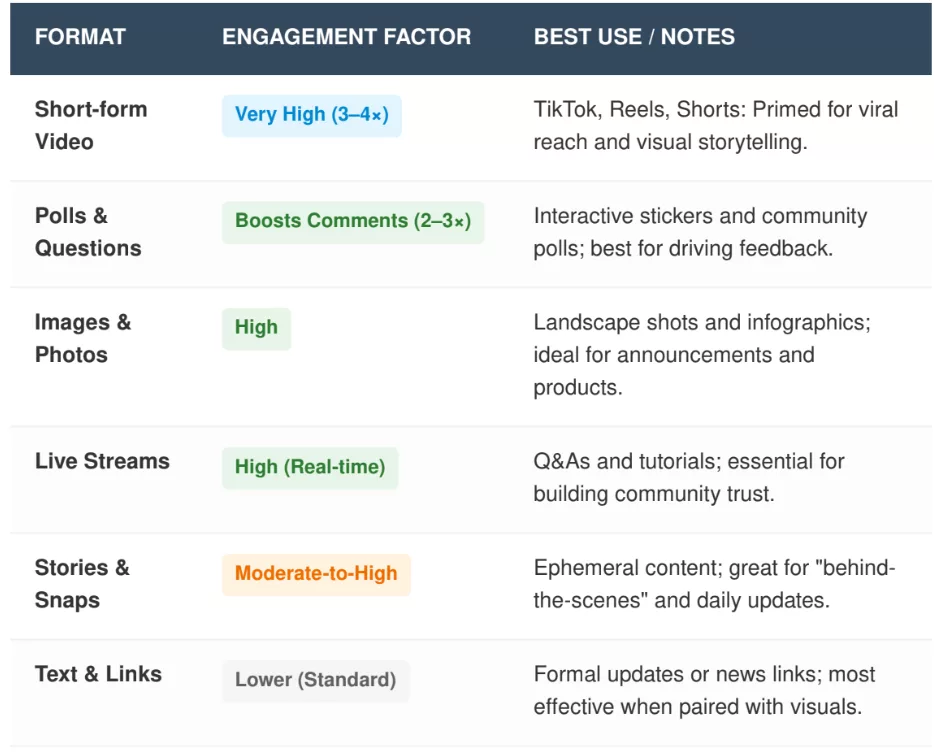
Regardless of format, posts in Burmese (or local dialects) outperform foreign-language content. Emojis, memes, and local cultural references increase relatability. Ideally, video dominates – TikTok trends and Facebook Watch: vertical short videos (15-60s) engage best. For example, an image-based infographic on Myanmar mobile stats yielded 3–4× more engagement than text posts in a local agency’s analysis[8].
Peak engagement times (by platform):
- Global insight suggests many users scroll early morning (6–8 AM) and late evening (9–11 PM)[8].
- Facebook in Myanmar sees a late-afternoon spike (~4 PM)[9].
- TikTok peaks around 7–8 PM when people relax[10].
- Instagram is active during mornings, lunch breaks, and evenings[20].
- LinkedIn suits mid-week business hours (Tue–Thu 10 AM–1 PM)[21].
- YouTube performs best on weekday afternoons and weekend mornings[22].
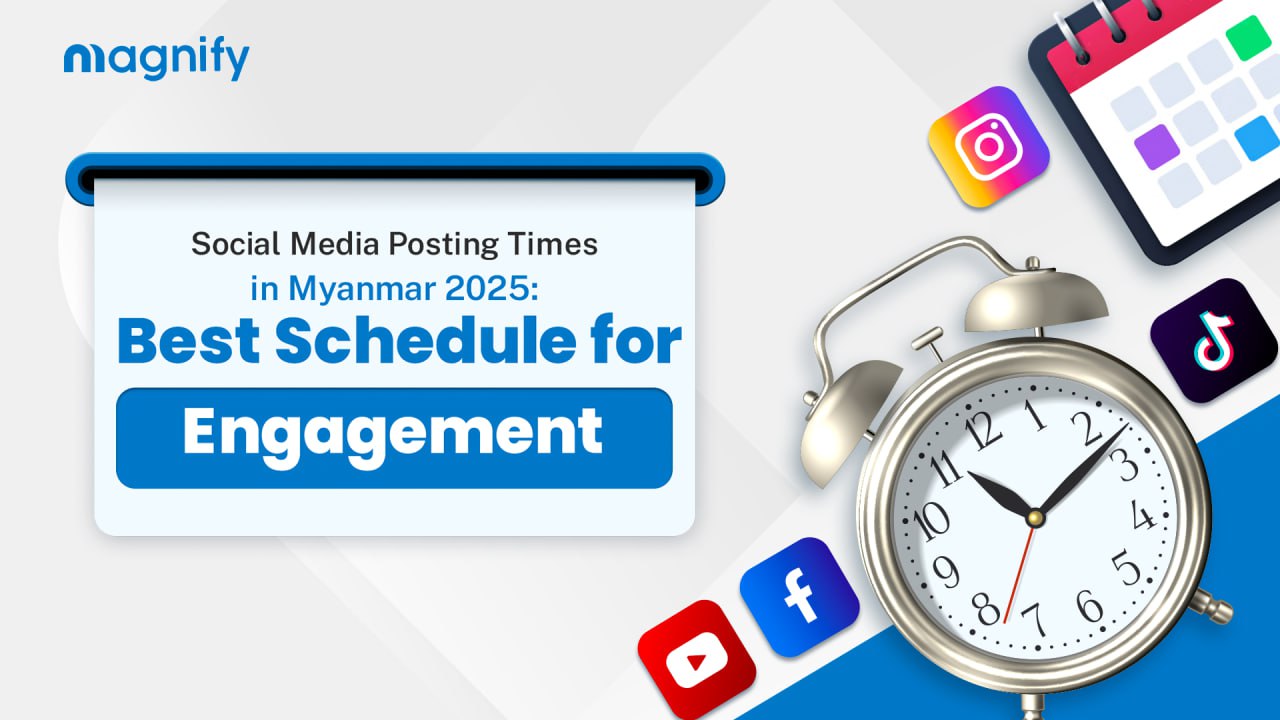
Optimizing to these slots can boost reach. In practice, content calendars schedule major posts around 7 AM (wake-up scroll), noon (lunch break), or after 7 PM. Live sessions or Story posts can fill gaps.
Figure: Demographic breakdown of Facebook users in Myanmar (NapoleonCat, Dec 2025). Young adults (25–34) form the largest group; gender is roughly balanced.
Platform demographics have practical implications: e.g., with ~50% of Facebook users aged 25–34【38†】, brands target millennials on FB. In contrast, TikTok in Myanmar skews male and young (about 39% female users[23]). Messenger’s user base (50% female[5]) suggests using chatbots and customer care. LinkedIn is small and urban-professional (largely 25–34[18]), so focus B2B content there.
Platform-Specific Strategies
- Facebook & Messenger: Still the largest user base for most brands. Use a mix of image posts, video (FB Live, Watch), and community engagement. Paid ads on FB remain vital for reach – CPMs are relatively low in Myanmar. Best practices: local-language content, community groups (FB Groups have high loyalty), and interactive posts (polls, quizzes). Case Study: ADDA Shoes (local footwear brand) used a “New Year, New ADDA” social campaign to double its page likes from ~18K to ~283K by July 2023[24], by encouraging fans to share New Year moments (371 comments, 2.3K reactions)[25]. Their case highlights consistent posting and contest-driven engagement on FB. Aim for ~3–5 FB posts/week (mix of posts and Stories) and daily Messenger/WhatsApp outreach.
- TikTok: The explosive growth channel in Myanmar. Content must be native TikTok style: short, trending music, authentic and entertaining. Brands should create narrative or challenge videos rather than direct ads. Case Study: BAWDAR Beer crafted a mini-series of relatable teen friend stories on TikTok, quickly amassing 100K followers and 5.7M views in 2.5 months, becoming the #1 beer brand on TikTok[26]. Lesson: storytelling over hard-sell. Posting at least 3–5 times/week (especially evenings around 7 PM[10]) is recommended to build momentum. Use branded hashtags and collaborate with local influencers (who are very effective on TikTok) to amplify reach.
- Instagram: For consumer brands (food, travel, fashion). Focus on high-quality photos and Reels. Engagement is driven by visual appeal and storytelling in captions (Burmese + English if targeting young bilinguals). Posting 3–5 feed posts per week plus daily Stories. Use relevant local hashtags. Influencer tie-ups and giveaways (e.g. following + tagging) work well. Instagram’s younger audience suggests lighter, creative content (memes, DIY, lifestyle).
Figure: Demographics of Instagram users in Myanmar (NapoleonCat, Dec 2025) showing 55.3% female and 44.7% male[17]. The 25–34 age group is largest.
- YouTube: Popular for entertainment and tutorials. Brands can post longer-form videos (product demos, how-tos, interviews). Leverage YouTube Shorts too. Publish ~1 video every 1–2 weeks; optimize for 2–4 PM on weekdays[22]. Ads via YouTube (Google Ads) can target high-income urban audiences. For example, tech and education brands do well here.
- Viber/Telegram: Essential “conversational” platforms. Viber (≈15M users[4]) is used for customer service and direct offers. Businesses run official Viber Community channels (broadcast) to share updates or promotions (users must opt-in). Since Viber bypasses algorithms, it gets high open rates. Telegram (≈6M active) is strong for niche communities and loyalty programs. Use them for announcements, signup broadcasts, and 1:1 support (e.g. banks and e-commerce use Viber chatbots). Viber and Telegram should be integrated into strategy for direct engagement and “closing” sales[4].
- Local platforms: No major new social networks, but note: Reddit and X have very small followings. Local content sites (Myanmar-language news portals) can be used for PR releases or native ads. SMS/MMS and popular local apps (e.g. KBZPay promotions) can complement social efforts.
Case Studies of Myanmar Campaigns
Multiple Myanmar brands have run successful social campaigns. Key examples:
- BAWDAR Beer – TikTok Mini-Series: To capture Gen Z, Bawdar launched a micro-drama series on TikTok about “friends” (the brand’s meaning)[27]. With authentic storytelling (no heavy branding), they hit 100K+ followers and a video with 5.7M views. In 2.5 months they became Myanmar’s top beer brand on TikTok[26]. Measurable Outcome: +100K fans, +5.7M views, #1 engagement in category. Insight: Narrative video content can explode engagement on TikTok.
- ADDA Shoes – Facebook Growth: Starting January 2021, local shoe seller ADDA had ~18K FB likes. Newness Agency’s “New Year, New ADDA” campaign encouraged fans to share New Year moments. The result: reactions jumped to 2.3K and comments 371, and page likes soared to ~283K by mid-2023[24]. Outcome: ~15× fan increase in 2.5 years. Insight: Consistent creative posting + contests drives organic follower growth on Facebook.
- Samudra Biscuits – Multi-Channel Push: Malaysian cookie brand Samudra used TV, TikTok videos, social giveaways and sampling. Their campaign achieved ~3.1 million reach and 4.7 million impressions online, while reducing product return rate to <10%[28]. Outcome: High digital reach (3.1M) and visibility (4.7M) in Myanmar. Insight: Combining social (incl. TikTok) with offline sampling builds awareness and brand trust.
- FAME Pharma – Art Competition: (Reported in [49]) This 2023 campaign invited Myanmar digital artists to design product packaging. It went viral among youth, positioning the pharmaceutical brand as community-focused. Note: While exact metrics are private, it illustrates using UGC (user-generated content) contests for engagement.
- Samsung “Love Letter” Campaign: (Reported in [49]) In 2022 Samsung Myanmar tapped the viral trend of online love letters. Their simple heartfelt posts on social garnered widespread shares and press attention. Insight: Emotion-driven, culturally resonant themes can outperform flashy ads.
- KFC TikTok Ads: Although a global case, KFC Myanmar could mimic the global TikTok campaign that achieved 14.9M+ impressions and 7.9M+ reach[29] by using TikTok’s In-Feed ads. For local use, similar strategies (catchy food videos, songs) can drive awareness among urban youth.
These examples show measurable success (followers, reach, engagement) and common threads: local cultural relevance, narrative content, and leveraging platforms natively.
Practical Recommendations for SMEs & Marketers
- Content Types: Prioritize high-engagement formats: short videos (Reels/TikToks) and striking images. Use local influencers or micro-influencers to co-create content. Mix educational/informative posts (e.g. tips) with entertaining posts (memes, stories). Use Burmese language predominantly, with occasional English or ethnic language when targeting specific groups.
- Posting Cadence: Consistency is key. As a rule, plan ~3–5 Facebook/Instagram posts per week, 3–5 TikToks/week, and 1–2 YouTube videos per month. Post Instagram Stories or Viber messages daily for top-of-mind presence. Below is a sample monthly content schedule template (add details per brand):
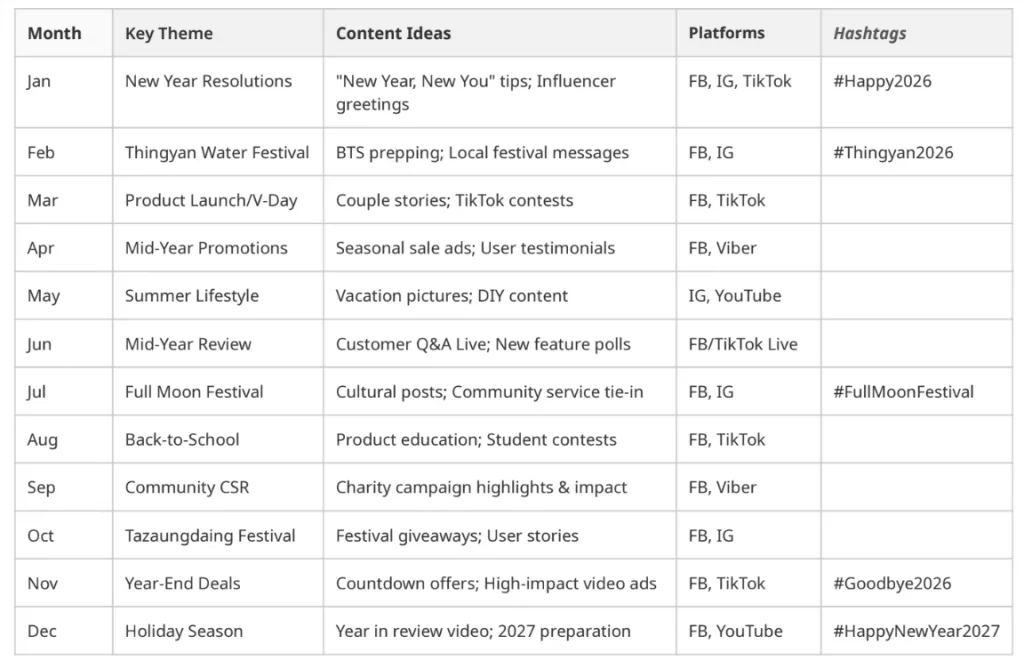
Table: Sample 12-month content calendar template (themes may vary by industry).
- Ad vs Organic Mix: Start with organic posts to build brand voice, then amplify key posts via paid ads. For Facebook/Instagram ads, even small budgets (~200K–500K MMK/month, i.e. ~USD100–250) can reach tens of thousands. Allocate ~20–30% of spend on brand awareness (top-funnel), ~70% on conversion goals (traffic, lead gen). Given low average CPMs in Myanmar, ads are cost-effective. Meanwhile, organic engagement (comments, shares) is crucial for algorithms, so schedule both. Use platform analytics to reallocate: e.g. boost posts that already get organic traction.
- KPIs to Track: Key metrics include follower growth, reach/impressions, and engagement rate (likes+comments+shares divided by reach). Also track click-through rate (CTR) to your site, conversion actions (sales, sign-ups), and cost per action for ads. For campaigns, measure specific outcomes (e.g. contest entries, video views). Sentiment and share-of-voice (via listening tools) gauge brand perception. Set SMART goals (e.g. “increase Instagram followers 20% in 6 months” or “improve engagement rate by 5%”).
Tools for Market Research & Social Listening
Local and global tools can help tailor strategy. For Myanmar content and language, Magnify Myanmar’s AI-powered social listening tool is designed to monitor Burmese-language conversations on news sites, forums, and social media[30]. It can track brand mentions, sentiment, and trending topics in real time. Global platforms like Brandwatch, Sprout Social, Hootsuite Insights, or Talkwalker can also be used, though they may not parse Burmese as well. Google Trends gives insight into search interest in local topics. Use platform-native insights (Meta Business Suite, TikTok Analytics, YouTube Studio) to analyze audience demographics and content performance. For competitive research, study local leaderboards (e.g. NapoleonCat) and agency reports.
In practice, set up keyword/hashtag alerts (e.g. brand name, industry terms) in these tools to watch customer feedback and emerging trends. For example, social listening may reveal a viral challenge or a competitor move early, allowing your brand to adapt content quickly. Regularly review analytics dashboards (weekly/monthly) to refine targeting and creative strategy.
Ethical & Legal Considerations
- Data Privacy: Myanmar currently lacks a comprehensive personal data protection law[11]. Nonetheless, companies should adopt global best practices: obtain user consent for data collection (e.g. cookies, mailing lists), allow opt-outs, and secure customer data. Treat user information (emails, contact info) with care. Note: the 2025 Cybersecurity Law penalizes spam/unwanted messaging (fines MMK5–20M or jail)[12], so always use opt-in methods for newsletters or Viber broadcasts.
- Advertising Regulations: Ads must comply with the Consumer Protection Law and local media guidelines. Avoid prohibited content: for instance, ads must not insult religion or national symbols[13]. Political or electioneering ads are heavily restricted (and outside this guide’s scope). Follow truth-in-advertising rules: no false claims (e.g. miracle cures) and no unfair comparisons. Influencer collaborations should be transparently disclosed.
- Content Ethics: Respect Myanmar’s cultural norms (family values, religion, language). Avoid sensitive political or ethnic topics entirely. Aim for positive, community-building messaging. If targeting minors (e.g. toys, education), take extra care and parental consent for any contest or data use.
- Platform Policies: Each platform has its own rules (e.g. no hate speech, no cyberbullying). Ensure all content abides by Facebook’s Community Standards, TikTok’s guidelines, etc. Periodically review these to avoid takedowns.
By following these guidelines and leveraging Myanmar-specific insights, businesses can craft a data-driven social media strategy tailored to local audiences. The charts and tables above summarize key metrics and best practices. For example, plotting platform user growth over time (line chart) or market share (pie chart) can help visualize where to invest. A suggested Mermaid flowchart of our strategy loop could be:
This end-to-end cycle (research → strategize → create → post → measure) ensures continuous improvement. Using tools like those above at each stage will keep your social media efforts both effective and compliant in Myanmar.
Sources: Authoritative reports and local industry analyses were used, including DataReportal’s Digital 2025/2026: Myanmar[2][1], NapoleonCat social stats[5][17], and insights from Myanmar digital agencies[24][4][9]. These, along with academic and news sources, provide the data and case examples informing the recommendations above.
[1] [2] [6] [7] [14] [15] Digital 2026: Myanmar — DataReportal – Global Digital Insights
[3] [16] [17] [23] Digital 2025: Myanmar — DataReportal – Global Digital Insights
[4] [19] Messaging Apps Usage & Engagement Report Myanmar (2025-2026) | Newness
[5] [18] Social Media Users in Myanmar – 2025 | NapoleonCat
[8] Social Media Landscape in Myanmar: The Complete Strategic Guide | Hashmeta
[9] [10] [20] [21] [22] Best Posting Time Myanmar: 2025 Social Media Guide
[11] Data protection laws in Myanmar – Data Protection Laws of the World
[12] Myanmar Cybersecurity Law Takes Effect – Tilleke & Gibbins
[13] avia.org
[24] [25] ADDA Myanmar Case Study | Newness
[26] [27] Case Study: How BAWDAR Beer Became #1 on TikTok in Under 3 Months
[28] Samudra Myanmar Digital Marketing Case Studies
[29] KFC | TikTok for Business Case Study
[30] Magnify Myanmar’s Social Listening and Media Monitoring Tool: Revolutionizing Industry Insights with AI-Powered NLP