Media Monitoring in Myanmar 2026: Print, Online and Social, in One Morning View
Ask a communications team in most of the world about media monitoring and they will talk about online articles, broadcast clips and social feeds. Ask the same question in Myanmar and you hit a fact the global playbook quietly forgets.
Here, print still matters. A great deal.
Newspapers, journals and weekly publications continue to shape opinion, set the agenda for the day, and reach audiences and decision-makers that never surface in an online dataset. A brand or organisation watching only the internet in Myanmar is watching an incomplete picture, confidently, every single day.
So a serious media monitoring strategy in this market is not a choice between print, online and social. It is all three, read together, fast enough to act on. This is a guide to what that actually takes in 2026, and where most setups fall short.
Why media monitoring matters more than ever
The job of media monitoring has not changed in spirit, but the stakes have risen. Communications and PR teams use it to do several things at once: protect reputation, prove the value of their work, watch competitors, and catch a problem while it is still small.
What has changed is speed. A story now travels from a single post or a single column to widespread awareness in hours, sometimes less. The window between “something is happening” and “everyone knows” has narrowed to the point where monitoring on a weekly, or even daily-but-late, basis is no longer monitoring. It is record-keeping after the fact.
The teams that stay ahead are the ones who see the coverage as it lands, across every channel where their audience actually pays attention, and who can search their entire media footprint the moment a question is asked. That last part is where most monitoring quietly breaks down.
The three pillars, and the one everyone underestimates
A complete view of the Myanmar media landscape rests on three pillars. Each answers a different question.
Print media monitoring
This is the pillar the rest of the world has largely retired and Myanmar has not. Print carries weight here, with credibility, reach, and influence over the people who matter, yet it is the hardest channel to monitor because the content does not arrive in a neat digital feed. Someone, or something, has to actually read the papers.
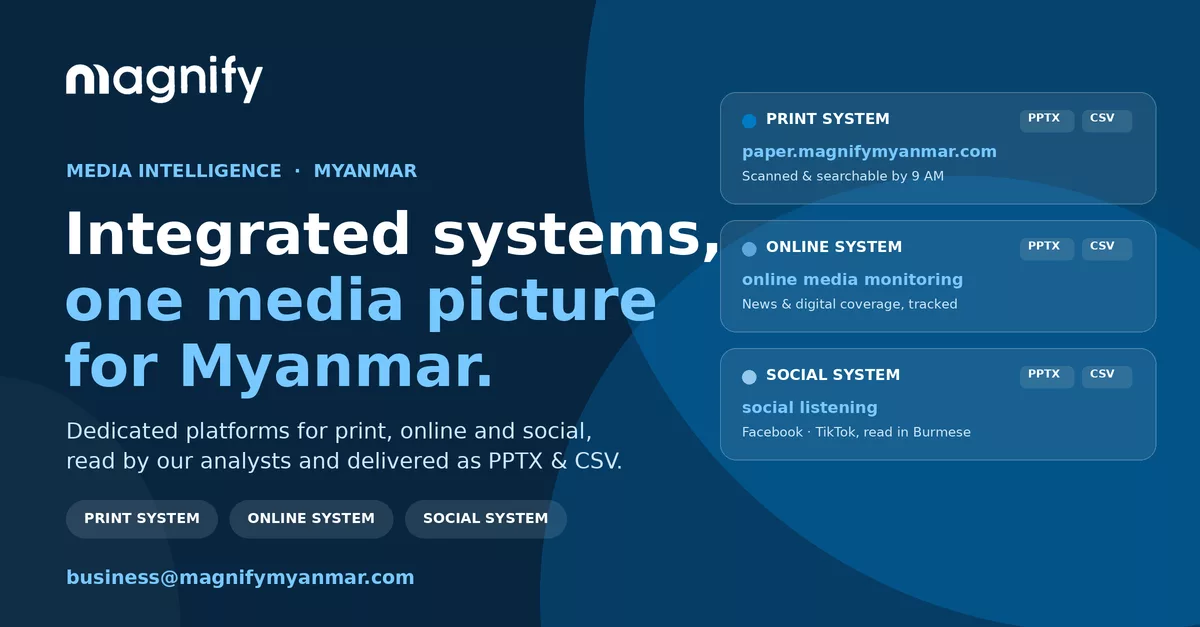
This is exactly the gap paper.magnifymyanmar.com was built to close. Every day, the newspapers are scanned and processed, and the coverage is ready for you by 9 in the morning, in a dashboard where you can search any keyword across that print content. Your brand, a competitor, an executive’s name, a policy term, a campaign slogan. Instead of clipping by hand or finding out days later that you were mentioned, you start the day already knowing.
The value is in the routine. Coverage you can rely on being there, searchable, before your first meeting, turns print from a blind spot into one of your sharpest early-warning channels.
Online media monitoring
Beyond print sits the fast-moving world of news sites, online journals and digital publications. Online monitoring tracks where and how your brand is being written about across the web, who is saying it, in what context, and whether the coverage is helping or hurting. It is how you measure the reach of a campaign, follow a story as it develops across outlets, and understand the narrative forming around you in close to real time.
Social media monitoring
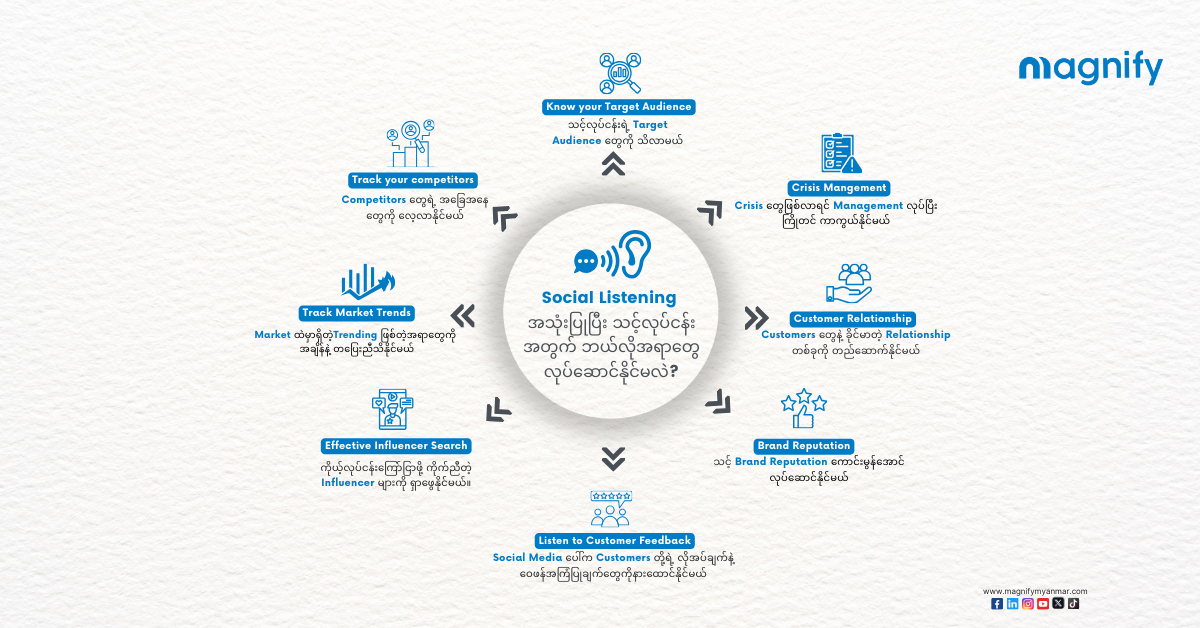
Then there is the conversation the public is having directly, on the platforms where Myanmar spends its attention. Social monitoring is where you hear the unfiltered voice of your audience: the praise, the complaints, the questions, the sentiment, and the first tremors of an issue long before it reaches a journalist. It is the most candid of the three, and the most revealing.
Each pillar on its own gives you a slice. The power is in holding all three at once, because that is the only way to see a story move. A complaint on social becomes a question to a journalist, becomes a column in print, becomes a wider online narrative. Watch one channel and you catch a fragment. Watch all three and you watch the whole arc, in time to shape it.
What good monitoring looks like in practice
Tools matter less than what they let you do. A media monitoring setup is working well when it delivers a few specific things.
- Speed you can build a morning around. Coverage should reach you early and predictably, not whenever it happens to be compiled. A dependable 9 AM print briefing is worth more than a faster feed you cannot count on.
- Search across everything. The real test is the moment a leader asks “what are they saying about us?” If you can type a keyword and pull every mention across print, online and social in seconds, you have a monitoring system. If you cannot, you have an archive.
- Sentiment that fits the market. Knowing you were mentioned is half the story. Knowing whether the mention helps or hurts, read correctly for how Myanmar audiences actually express themselves, is the other half.
- A single view, not five tabs. Coverage scattered across separate tools for separate channels is coverage no one has time to connect. One dashboard that brings print, online and social together is what turns monitoring into intelligence.
- Proof for the people you report to. Good monitoring quietly answers the hardest question in communications: did our work land? Reach, share of coverage, sentiment shift, and competitive comparison are how a comms team shows its value in numbers.
Where this is heading
Media monitoring in Myanmar is moving the same direction as everywhere else, toward faster, smarter, more automated reading of more sources at once. AI is making it possible to process far more coverage, summarise it, and surface what matters without a human scanning every line.
But the Myanmar-specific truth holds underneath the technology. The market that monitors print, online and social together, in a language and a media reality the global tools were not built for, sees more than the market that monitors only what is convenient. The advantage is not just having the data. It is having the whole of it, early enough to do something with it.
See your whole media picture, every morning
At Magnify, we monitor all three pillars of the Myanmar media landscape so your team never has to choose which part of the story to miss. Print scanned and searchable by 9 AM through paper.magnifymyanmar.com, online coverage tracked as it publishes, and social conversation read for what it really means, brought together where you can search it, measure it, and act on it.
If your current monitoring leaves print as a blind spot, or scatters your coverage across tools that do not talk to each other, it is worth a conversation.
Let’s build your morning media view. Reach our team at business@magnifymyanmar.com and we will show you what it looks like to start every day already knowing the whole story.
Magnify Myanmar — Media Monitoring, Social Listening & Market Intelligence, built for Myanmar.