Transform PR in Myanmar: Why Three Specialist Systems Beat One Blind Spot
Most communications teams in Myanmar are flying on one instrument.
Some watch social media closely and barely glance at print. Some live in the newspapers and miss the conversation happening on Facebook and TikTok. The result is the same either way: confident decisions made on the half of the story they happened to see.
Reputation in Myanmar does not respect those boundaries. A complaint starts in a comment thread, becomes a question to a journalist, lands as a column in a morning paper, and spreads back across online news by the afternoon. Watch only one stage of that journey and you are always reacting late to a story you could have shaped early.
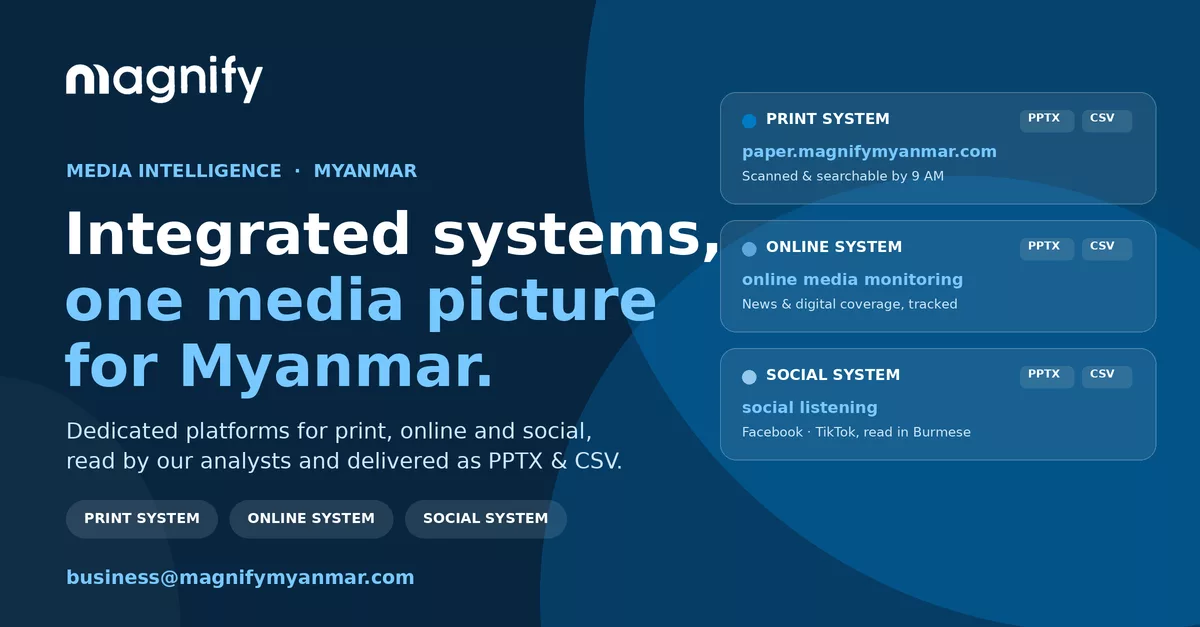
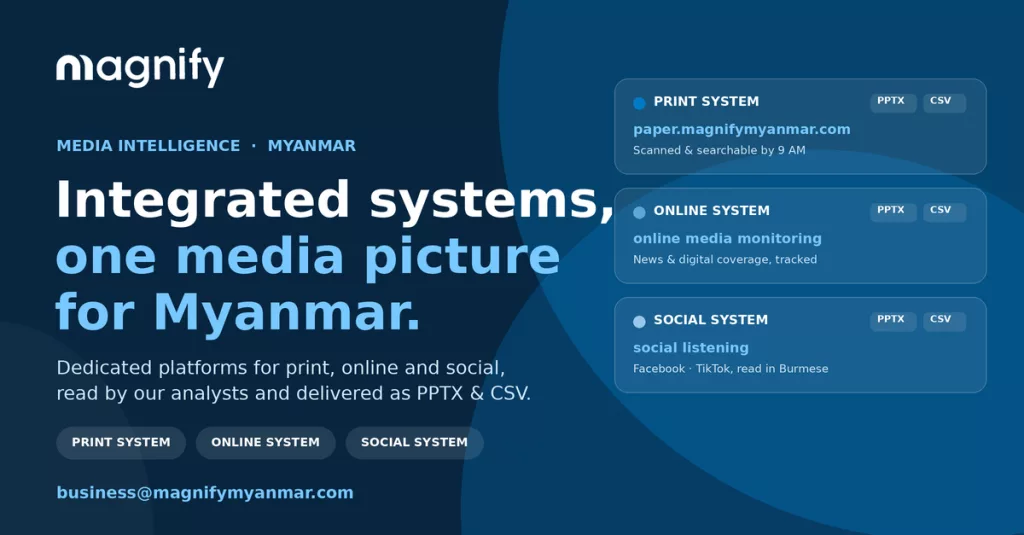
The fix is not a single magic dashboard that claims to do everything at once. Each channel behaves differently and deserves a tool built for it. That is why Magnify runs three specialist media monitoring systems, one for print, one for online, and one for social, all built and owned by us, each tuned to how its channel actually works in Myanmar, and all read by the same analysts so the insight comes back to you as one coherent picture. Here is how that works, and why it matters more in this market than almost anywhere else.
Three systems, because three channels are not the same
Print, online and social move at different speeds, in different formats, with different signals. Forcing them into one generic feed flattens exactly the nuances that matter. Magnify keeps a dedicated system for each, so every channel is monitored properly rather than approximately.
The Print System: paper.magnifymyanmar.com
This is the channel the rest of the world has largely retired and Myanmar has not. Newspapers and journals still set the agenda and reach decision-makers who never appear in an online dataset, yet print is the hardest channel to monitor because the content does not arrive in a tidy digital feed. Someone has to actually read the papers.
That is what paper.magnifymyanmar.com does. Every morning the newspapers are scanned and processed, and the coverage is ready for you to search by 9 AM, by any keyword, across that day’s print. Your brand, a competitor, an executive, a policy term. Instead of clipping by hand or learning days later that you were mentioned, you start the day already knowing.
The Online Media System
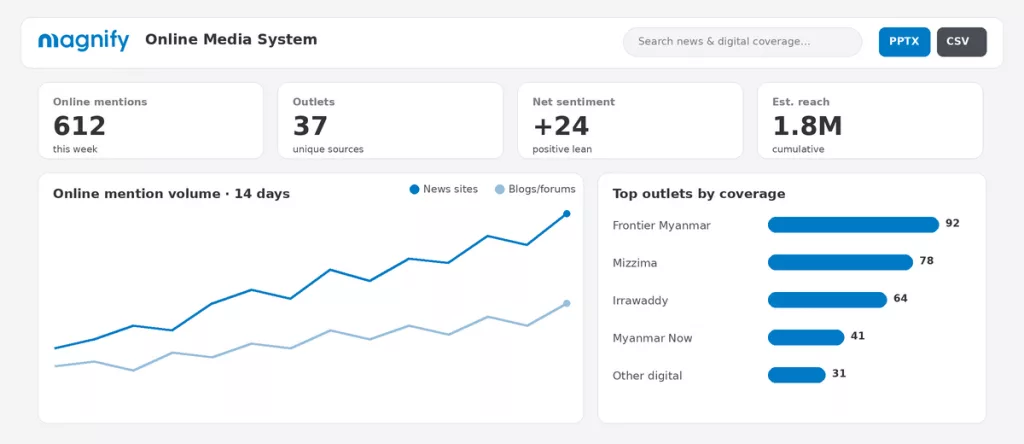
Beyond print sits the fast-moving world of news sites, online journals and digital publications. The Online System tracks where and how your brand is written about across the web, which outlets are driving the story, in what tone, and whether coverage is helping or hurting, so you can measure a campaign’s reach and follow a narrative as it develops.
The Social Listening System
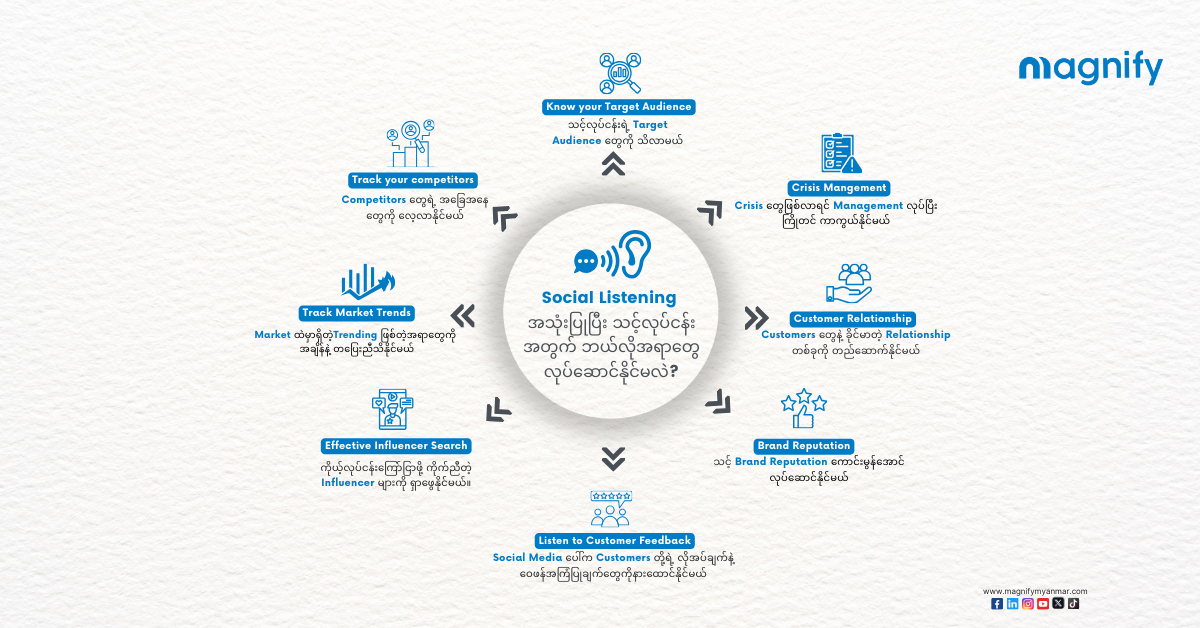
Then there is the public conversation itself, on the platforms where Myanmar spends its attention. The Social System captures the unfiltered voice of your audience across Facebook and TikTok: the praise, the complaints, the questions, and the first tremors of an issue long before it reaches a journalist.
Crucially, this is where reading the language correctly decides everything. Global sentiment tools were built for English-first text and quietly choke on Burmese: no spaces between words, more than one text encoding still in circulation, heavy mixing of Burmese and English, romanised Burmese, slang and relentless sarcasm. Faced with text they cannot parse, they default huge volumes of comments to “neutral.” Neutral is not always neutral. Often it just means the software gave up reading. Our social system is built to read Burmese the way Burmese is actually written and typed, so the sentiment reflects what your audience truly means.
The negative trends, read by people, not by a popup
Here is an important distinction in how Magnify works, and one we think is a strength rather than a limitation.
Our systems surface trends, including negative ones: a sentiment line that turns downward, a cluster of similar complaints, a sudden rise in a worrying topic. What the systems do not do is fire an automatic in-app alert and leave you to interpret a red icon on your own. Instead, every meaningful trend is read and interpreted by our analysts, who trace it to its source, judge how serious it really is, and tell you what it means in plain language.
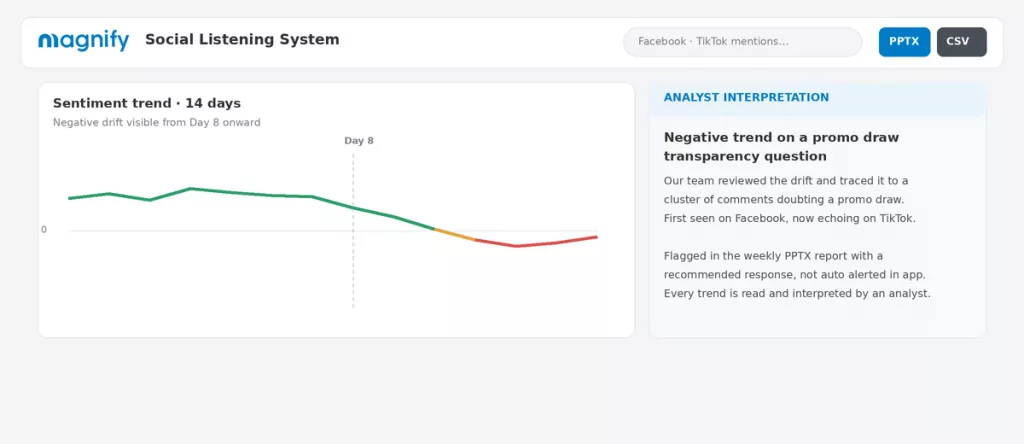
That matters because an automated alert without context creates noise and false alarms. A drop in sentiment might be a genuine problem, or it might be a spike of harmless sarcasm, or one loud voice that will pass by morning. The judgement of whether something deserves your attention is exactly where experience earns its keep. So when Magnify flags a negative trend, it arrives with a cause, a read on severity, and a recommended response, not just a number turning red. You get an interpretation you can act on, not an inbox of alerts you have to decode yourself.
Delivered the way your team actually works: PPTX and CSV
Insight that stays trapped in a tool is insight nobody uses. Magnify delivers from all three systems in the formats communications teams genuinely work in.
Reports come as PowerPoint (PPTX), ready to present to leadership or a client with the narrative and analyst interpretation already built in, and as CSV, so your own analysts can slice the underlying data, build their own views, or feed it into other tools. One is the story for the room; the other is the raw material for deeper work. Between them, the insight moves easily from our systems into your meetings and your own analysis.
Why this combination wins in Myanmar
Put the three together and the picture becomes whole. A complaint first seen on social, a question that surfaces online, a column that lands in print, all read by the same team that can see how the story is moving between channels, and reported back to you in PPTX and CSV with a human interpretation attached.
That combination delivers what every communications team actually wants:
- Print that’s never a blind spot. Searchable by 9 AM through paper.magnifymyanmar.com, not ignored the way global tools ignore it.
- Online coverage tracked as it publishes, so you can prove reach and follow the narrative.
- Social read in Burmese, for what your audience truly means, not rounded to a meaningless “neutral.”
- Negative trends interpreted by analysts, with cause, severity and a recommended response, instead of an alert you must decode alone.
- Reports in PPTX and CSV, ready for the boardroom and for your own deeper analysis.
- Share of voice and sentiment you can put in front of leadership to show that PR is a driver, not a cost.
See your whole story, every morning
At Magnify, we built three specialist systems for the three pillars of the Myanmar media landscape, all owned and run by us, so your team never has to choose which part of the story to miss. Print scanned and searchable by 9 AM through paper.magnifymyanmar.com, online coverage tracked as it publishes, and social conversation read in Burmese for what it really means, with every trend interpreted by our analysts and delivered to you in PPTX and CSV.
If your monitoring today leaves print as a blind spot, or hands you a suspiciously calm “neutral” you do not quite trust, or buries you in context-free alerts, those are exactly the gaps this approach closes.
Let’s build your morning media view. Reach our team at business@magnifymyanmar.com and we will show you what it looks like to start every day already knowing the whole story, across every channel, interpreted and ready to present.
Magnify Myanmar. Media Monitoring, Social Listening & Market Intelligence, built for Myanmar.