Why Most Social Listening Tools Are Functionally Illiterate in Myanmar
There is an uncomfortable truth behind a lot of social listening in Myanmar, and almost nobody says it out loud.
Most of the tools doing the listening cannot actually read.
Not properly. Not the way the language is really used. A global platform will happily produce a clean dashboard full of confident charts about your Myanmar audience, and a good portion of what feeds those charts is the software politely guessing, because the language defeated it somewhere upstream. The charts still look great. That is the dangerous part.
If you are making brand decisions off that data, it is worth understanding exactly where the reading breaks down, and why this is a genuinely hard problem rather than a lazy one.
Burmese was built to break English-first software
Most of the world’s natural language processing was designed around languages like English. Words separated by spaces, a familiar alphabet, decades of training data. Burmese quietly violates almost every one of those assumptions.
There are no spaces between words. This sounds like a small thing. It is not. In English, software finds words by looking for the gaps. Burmese traditionally does not put gaps between words at all, so before a tool can analyse anything, it first has to figure out where one word even ends and the next begins. This is a famously hard problem called word segmentation, and it is the foundation everything else is built on. Get it wrong, and the meaning collapses.
Here is the easiest way to feel it. Imagine an English comment arrived with no spaces: “thefoodwasnotbadatall.” Now imagine your software splits it in the wrong place and reads “not” as belonging to a different phrase. A glowing review just became a complaint, or a complaint became praise. In Burmese, that ambiguity is not an edge case. It is every single sentence.
There were two competing ways to type the language. For years, Myanmar was split between two incompatible text encodings, Zawgyi and Unicode. The same comment could be stored in two completely different ways under the hood. A tool that only understands one of them sees the other as gibberish. Even today, older content and some users still produce text that has to be detected and converted before it can be read at all. Skip that step, and you are not analysing a chunk of your audience, you are silently dropping them.
Burmese is a low-resource language. In plain terms, the global research and training data that makes AI fluent in English, Spanish or Chinese barely exists for Burmese. Fewer datasets, fewer benchmarks, fewer pre-built tools. When researchers test large language models on lower-resource languages, performance drops off noticeably compared to the major ones. The fluency you take for granted in English simply has not been built yet for Burmese, unless someone deliberately builds it.
Now add how people actually talk online
The script is only the first hurdle. Real Myanmar social media adds a second layer that even many Burmese-aware tools stumble over.
People code-switch constantly, mixing Burmese and English inside a single sentence. They type Burmese using English letters when they cannot be bothered to switch keyboards. They lean on slang, abbreviations, and inside jokes that shift every few months. And like everyone else online, they are heavily sarcastic, and they communicate enormous amounts through emoji and stickers that carry meaning a keyword search will never catch.
A keyword tool counts the word. It has no idea the word was being used to mock you.
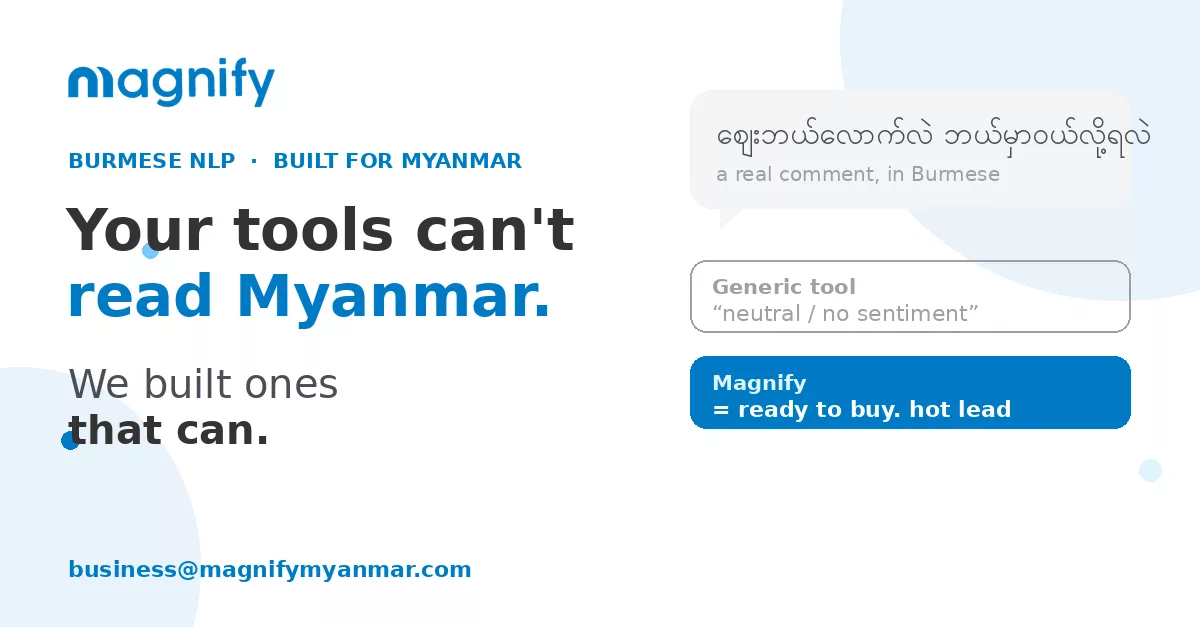
So when an off-the-shelf international platform processes Myanmar comments, the most common failure is not a dramatic error. It is something quieter and worse: it shrugs. Unsure how to classify text it cannot fully parse, it defaults huge volumes of comments to “neutral.” Your dashboard then tells you sentiment is calm and balanced, when in reality you are looking at a wall of enthusiasm, or a slow-building complaint, that the software simply could not hear.
Neutral is not always neutral. Sometimes neutral just means “I gave up reading this.”
What changes when the tool can actually read
This is the gap we built Magnify to close, and it is the difference between counting Myanmar and understanding it.
Reading the language properly means handling Burmese the way Burmese is actually written and typed: segmenting words correctly, normalising the encoding mess before analysis rather than after, and recognising mixed Burmese-English, romanised Burmese, slang and sarcasm as real signal instead of noise. That is the unglamorous foundation, and most tools never lay it.
Layering modern language models on top of that foundation is what turns reading into comprehension. Done right for this market, it means a model can tell the difference between a genuine compliment and a sarcastic one. It can recognise that a short, simple question like “how much, and where can I buy it” is not neutral chatter, it is a customer with their wallet open. It can group thousands of differently worded complaints into the handful of real issues underneath them. It can read the emoji as part of the sentence, not as decoration to be stripped out.
The practical payoff is not abstract:
- Sentiment you can trust, because the comments were actually read rather than rounded to neutral.
- Buying signals you would otherwise miss, surfaced as leads instead of buried in a volume count.
- Early warning on trust and quality issues, caught while they are still a handful of comments rather than a crisis.
- A view of your whole audience, including the ones writing in Zawgyi, in slang, or in half-English, who other tools quietly discard.
That last point matters more than it looks. Every comment a tool cannot read is a customer it has decided does not count. In a market this digital and this expressive, that is an expensive blind spot to leave running.
The bottom line
A dashboard is only as honest as the reading underneath it. In Myanmar, the reading is the entire game, and it is precisely where generic, English-first tooling falls quietly short. The language does not bend to fit the software, so the software has to be built to fit the language.
That is the work we do. We built our social listening for Myanmar specifically, on Burmese-aware language processing and models tuned for how this market actually talks, so that the insight you act on is based on what your customers truly said, not on a confident guess about text the tool could not parse.
If you have ever looked at a suspiciously calm “neutral” sentiment score for your Myanmar campaigns and wondered what it was really hiding, that instinct is worth following.
Let’s find out what your audience is actually saying. Reach our team at business@magnifymyanmar.com and we will show you the difference between counting Myanmar and understanding it.
Magnify Myanmar — Social Listening & Market Intelligence, built for Myanmar.